Beware the biomass economy: pellets, jet fuel and the carbon-neutral claim
· 8 min read · by Joaquín Ferreyra
In October 2011, in the run-up to Rio+20, a short essay warned that the "green" in the green economy was often meant literally. Leaves, stalks, wood, algae and grass were being relabeled as "biomass" and lined up as industrial feedstock, and the author predicted a scramble to lock up land and plant matter the way earlier generations locked up oil fields. Fourteen years later the bioeconomy is official policy in dozens of countries. That makes it a good moment to look at what it actually demands, who supplies it, and whether its central carbon claim holds up.
The pitch
The case for a bioeconomy is chemically tidy. Industry runs on fossil carbon dug from underground. Plants pull carbon from the air every growing season. Swap the first for the second, the argument goes, and you can keep making fuel, plastics and chemicals while closing the carbon loop.
Governments took it up. The European Union adopted a bioeconomy strategy in 2012 and updated it in 2018. Brazil used its G20 presidency in 2024 to launch a G20 initiative on the bioeconomy, which agreed a set of high-level principles, and carried the theme into its role as host of the COP30 climate talks in Belém in November 2025. Biomanufacturing strategies in the United States, China and elsewhere rest on the same logic.
What the pitch tends to skip is volume. Fossil carbon comes concentrated in seams and reservoirs. Plant carbon is spread thinly across land that is already busy growing food, holding forests and housing everything else that lives. A tonne of fresh-cut wood carries far less energy than a tonne of oil. Replacing one with the other at industrial scale means moving enormous quantities of plant matter, and that is where the trouble starts.
Where the demand comes from
| Demand stream | Typical feedstock | Main policy driver |
|---|---|---|
| Power and heat | Wood pellets, chips, forestry residues | Renewable-energy subsidies in the UK, EU, Japan and South Korea |
| Road biofuels | Corn, sugarcane, soy and palm oil, used cooking oil | Blending mandates in the US, EU, Brazil and Indonesia |
| Aviation fuel | Waste fats and oils today; crops and residues next | EU and UK blending mandates; the aviation offsetting scheme CORSIA |
| Plastics and chemicals | Sugarcane, corn starch, vegetable oils | Corporate pledges, packaging rules |
| BECCS | Any of the above, with the CO2 captured and stored | Net-zero pathways in climate models; carbon-removal credits |
Wood for electricity
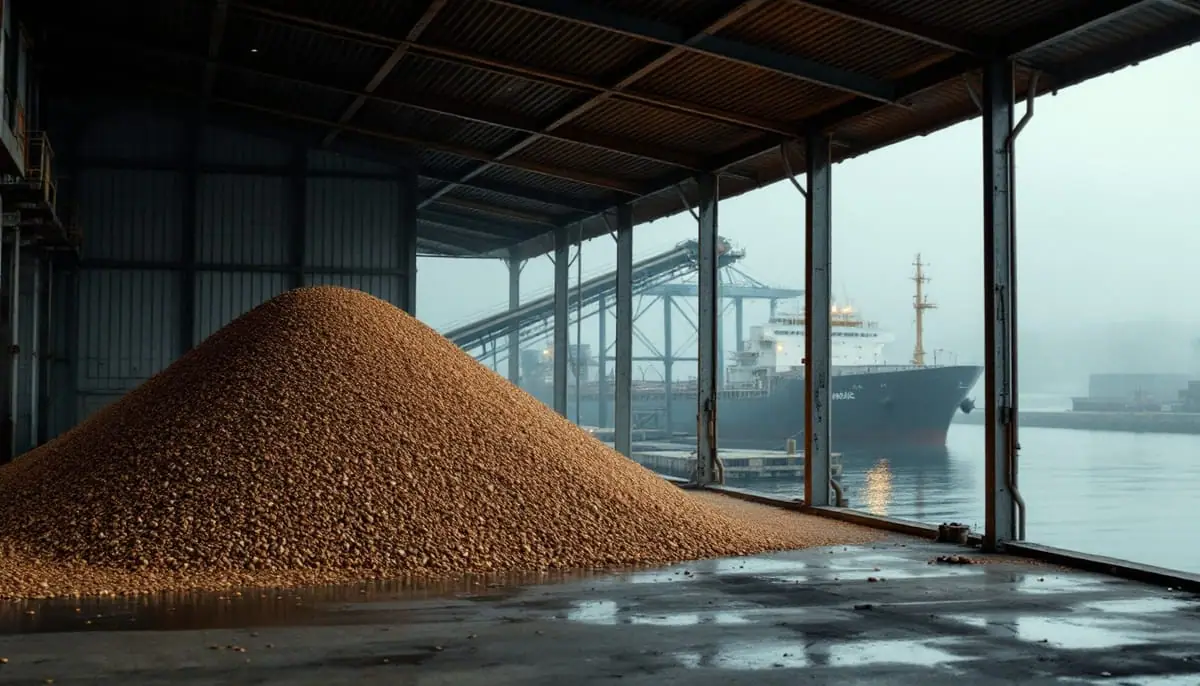
The flagship is Drax, the power station in North Yorkshire that converted four of its six coal units to burn wood pellets, most of them shipped from the southern United States and Canada. Drax became a pellet producer in its own right when it bought Canada's Pinnacle Renewable Energy in 2021. Its sourcing has been the subject of repeated journalistic investigations, and in 2024 the energy regulator Ofgem opened an investigation into how the company reported where its biomass came from. In 2025 the UK government agreed a new, smaller subsidy deal to keep the plant burning pellets from 2027 to 2031, tied to stricter sourcing conditions.
The supply side shows how fragile the model can be. Enviva, until then the largest US pellet producer and a major supplier to European and Asian utilities, filed for bankruptcy in March 2024.
Liquid fuels for cars and planes
Road biofuels are the older story, covered here before in posts on biofuels and GM crops and on Canada's biofuels law. In the United States, ethanol takes something like a third of the corn crop before you credit back the distillers' grains that return to animal feed. Indonesia raised its palm-based biodiesel blend to 35% in 2023 and to 40% from the start of 2025, turning a growing slice of the world's largest palm oil supply into diesel.
Aviation is the new frontier. The EU's ReFuelEU Aviation regulation requires fuel suppliers at EU airports to blend in 2% sustainable aviation fuel from 2025, rising to 6% in 2030 and 70% by 2050, with a rising sub-quota for synthetic fuels. The UK's own mandate took effect in 2025. Most of today's SAF is made from used cooking oil and animal fats, which are finite. Demand for "waste" oil has already outrun supply in some markets, and European authorities have looked into imports suspected of being virgin vegetable oil relabeled as waste. When genuine waste runs short, the next feedstocks on the list are crops and forestry residues.
Plastics and chemicals
Bioplastics remain a sliver, well under 1% of global plastics production by the industry's own counts. The best-known examples are polylactic acid made from corn starch by NatureWorks, a joint venture of Cargill and Thailand's PTT Global Chemical, and polyethylene made from sugarcane ethanol by Brazil's Braskem. "Bio-based" and "biodegradable" are different claims. Plenty of bio-based plastic is chemically identical to the fossil version and lasts just as long in a river.
BECCS
Bioenergy with carbon capture and storage is the most ambitious idea of all: grow biomass, burn or ferment it, capture the CO2 and bury it, for "negative emissions". Many of the pathways assessed by the IPCC that hold warming to 1.5°C rely on large amounts of carbon removal, and BECCS has supplied much of that in the models. Real projects are few. The best-known working example captures CO2 from ADM's corn ethanol plant in Decatur, Illinois, where fermentation yields an almost pure CO2 stream that is relatively cheap to catch. Drax has proposed adding capture in Yorkshire, contingent on government support. The IPCC's 2019 special report on climate change and land warned that bioenergy at the scale some scenarios assume would compete with food production and ecosystems for land.
Who controls the supply
The 2011 warning was about capture: of land, of feedstock, of the value added in processing. The supply chains built since have a familiar shape, with scattered growers at one end and a concentrated middle.
The crops behind liquid biofuels pass through the same traders that dominate grains and oilseeds. ADM, Bunge, Cargill and Louis Dreyfus all run crushing, refining or biofuel operations, alongside Asian palm-oil groups such as Wilmar. Renewable diesel and SAF from fats and oils come from a small number of specialist refiners, with Finland's Neste the largest. In Brazil, much of the sugarcane ethanol business sits with Raízen, a joint venture of Shell and Cosan. Wood pellets concentrate around a few export terminals and a few big producers selling to a few big utilities. Apply the concentration measures used for meatpacking to these chains and the bottlenecks show up in processing and logistics, not in the forest or the field.
Land is the other half of it. Biomass grows fastest in the tropics, and the most land-hungry feedstocks (sugarcane, oil palm, plantation trees) expand there. Even waste-based fuels lead back to land once the waste is used up. A mandate written as a percentage does not care where the next tonne comes from.
Is burning biomass carbon-neutral?
This is the claim the whole structure rests on, and the most misunderstood.
The convention. Under IPCC guidelines for national greenhouse-gas inventories, CO2 from burning biomass is not counted in the energy sector. That is a bookkeeping rule to avoid counting the same carbon twice, on the assumption that the loss is recorded in the land sector when the tree is cut. It is not a finding that the emissions are zero, and the IPCC has said plainly that its guidelines do not treat bioenergy as automatically carbon-neutral.
The gap. The convention only works if the land sector records the loss. When pellets made from American forests are burned in Britain, the UK books zero at the smokestack and the harvest falls into the US land-sector inventory, under another government's rules and targets. Nobody's climate goal feels the full emission.
The debt. Burning wood releases its carbon at once; regrowing the forest takes it back over years or decades. Per unit of electricity, a wood-fired plant typically emits more CO2 at the stack than a coal plant, because wood holds less energy per tonne and often more water. Whether that "carbon debt" is repaid depends on what is burned and what would have happened otherwise. Sawmill residues that would have rotted or been burned anyway pay back quickly. Whole trees from forests that would otherwise have kept growing may not pay back in the time that matters for climate targets. A 2021 review by the European Commission's Joint Research Centre made the point systematically, sorting forest-bioenergy pathways into those that help the climate and those that make things worse.
The defense. Supporters argue that where forest carbon stocks are stable or rising across a whole forest region, harvesting for energy is part of a sustainable cycle; that pellet mills mostly take low-grade wood and residues; and that biomass replacing coal beats coal. Each point holds somewhere, for some feedstocks. That is why the fight is about rules and verification rather than physics.
The EU tightened its rules in the 2023 revision of its Renewable Energy Directive, limiting support for power-only plants that burn forest biomass and requiring a "cascading" principle that puts higher-value uses of wood ahead of burning. The UK's new deal with Drax leans on sourcing conditions. Both depend on auditing long supply chains, which is exactly where the earlier problems turned up.
What the 2011 warning got right
Not every forecast from that era landed. Algae fuels, a favorite of investors at the time, mostly fizzled, and several synthetic-biology firms that promised to turn sugar into diesel pivoted to higher-value products or folded. The green economy vocabulary has been rebranded more than once.
The core of the warning holds. Mandates written in percentages have created durable demand for plant matter. That demand flows through a small number of processors and traders. And the carbon claim that justified it rests on an accounting convention never designed to carry that weight. When a bioeconomy strategy promises to replace fossil carbon with plant carbon, the first question to ask is how many hectares, and whose. The second is who owns the mill.

Written by Joaquín Ferreyra
Joaquín tracks mergers, market shares and the business models behind agribusiness, pharma and big tech. He likes a good concentration ratio and distrusts any market where four companies sell most of everything.