How carbon credits work: from a project's tonne to a company's claim
· 9 min read · by Joaquín Ferreyra
Book links may earn us a commission. As an Amazon Associate I earn from qualifying purchases.
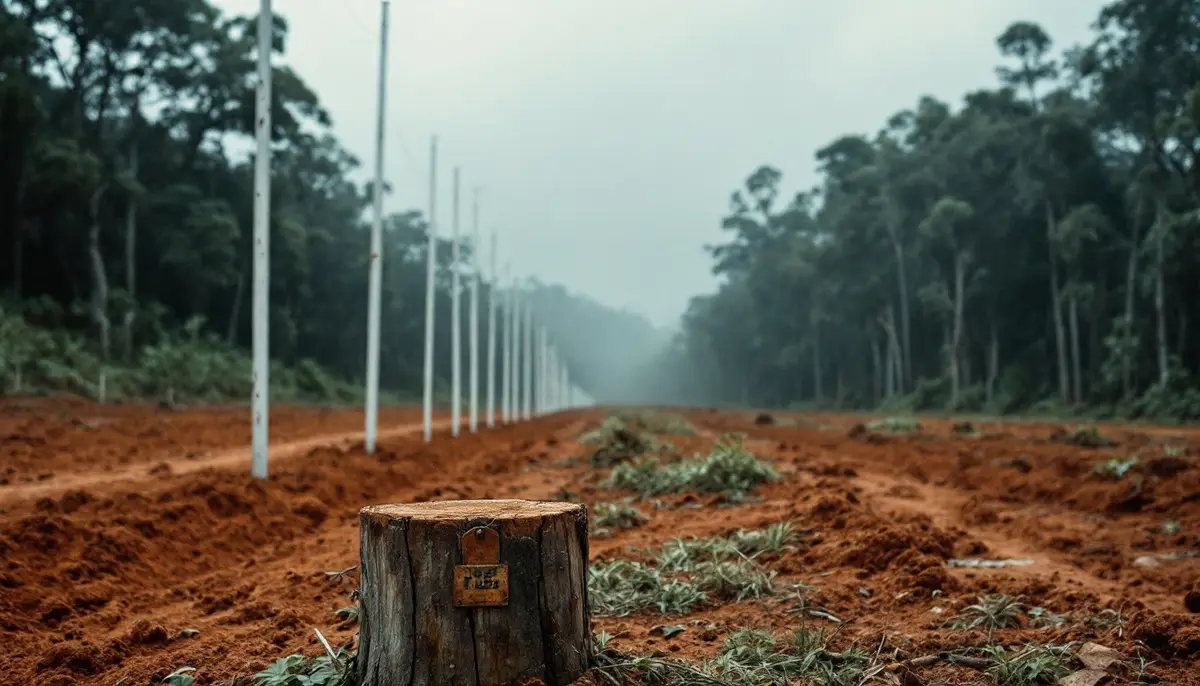
A carbon credit is a certificate that stands for one tonne of carbon dioxide, or the equivalent amount of another greenhouse gas, kept out of the atmosphere or taken back out of it. A project earns credits by following an approved method for counting its tonnes. An auditor checks the count, and a registry issues the credits with serial numbers. A buyer who wants to set that tonne against its own emissions "retires" the credit, which removes it from the market for good.
That is how carbon credits work on paper. In practice nearly every step leans on an estimate of something that did not happen: the forest that would have been cleared, the methane that would have escaped, the diesel generator that would have kept running. The tonne is real only if that estimate is honest, and nobody can walk out and inspect it. Most of what follows is about that gap, and about the people paid to estimate it.
Two markets that share a name
People talk about "the carbon market" as if there were one. There are two.
Compliance markets exist because a law says so. In a cap-and-trade system a government sets a ceiling on emissions from covered industries and hands out or auctions allowances up to that ceiling. Each allowance is a permit to emit one tonne. The EU Emissions Trading System, running since 2005, is the oldest large example. California runs one linked with Quebec, and China launched a national system for its power sector in 2021. Allowances are not offsets. They are slices of a cap, not tonnes from a project. Some compliance systems do let firms cover a limited share of their obligation with project credits, and CORSIA, the offsetting scheme for international aviation, is built around them.
The voluntary market is where companies, universities, event organizers and individuals buy credits to back claims such as "carbon neutral" or "net zero". No law requires the purchase. The rules come from private standards, the largest being Verra's Verified Carbon Standard and the Gold Standard, alongside smaller registries and newer specialists in carbon removal. Each standard approves methodologies, accredits auditors and runs a registry.
| Compliance market | Voluntary market | |
|---|---|---|
| What is traded | Mostly government allowances, some approved project credits | Project credits |
| Who writes the rules | Governments and regulators | Private standards, with growing outside review |
| Why buyers buy | Legal obligation | Corporate targets, marketing, reputation |
| Typical failure | A cap set too generously | Credits that overstate real tonnes |
The life of a credit
Strip out the jargon and a project credit passes through six steps.
- Design. A developer picks a methodology, the rulebook for a project type such as capturing landfill methane, handing out efficient cookstoves or protecting a forest. It sets out how to estimate the baseline (what would have happened anyway) and how to measure results.
- Validation. An accredited auditor, paid by the developer, checks the design against the methodology.
- Monitoring. The project measures what it did: methane flared, stoves in use, hectares still standing.
- Verification. An auditor checks the monitoring report, usually every year or every few years.
- Issuance. The registry creates credits for the verified tonnes, each with a serial number tied to the project and a vintage, the year the reduction happened.
- Retirement. Credits change hands, often through brokers, until someone retires them in the registry, usually naming the company it was done for. A retired credit cannot be resold.
The registry stops one tonne being sold twice inside a single standard. It cannot stop the same tonne being claimed by a company and by the country where the project sits. That is Article 6's job, further down.
Avoidance and removal
Credits fall into two broad families, and buyers increasingly care which one they hold.
Avoidance and reduction credits pay for emissions that did not happen: a cookstove that burned less wood, a forest left standing, methane destroyed instead of vented. Most credits issued in the voluntary market so far belong here.
Removal credits pay for carbon pulled out of the air. Nature-based removals include tree planting and building soil carbon. Engineered removals include direct air capture with underground storage, carbon mineralized into rock and biochar, which locks plant carbon into a stable charcoal.
The difference shapes what a buyer can honestly say. An avoidance credit records that someone else polluted less; the buyer's own tonne is still up there. A removal credit at least takes a tonne back. That is why the Oxford Offsetting Principles, first published in 2020, urge buyers to shift over time toward removals with long-lived storage. Durable removals are also scarce and far more expensive per tonne, which is why the shift has been slow.
Additionality, baselines and leakage
The central question for any credit is additionality: would this tonne have been saved without the money from selling the credit? If a wind farm was already the lowest-cost choice and would have been built anyway, credits from it pay for nothing new. Verra reached that conclusion itself and in 2019 stopped accepting most new grid-connected wind, solar and hydro projects outside the least developed countries.
Additionality rests on a baseline, a forecast of the world without the project. For a landfill with no legal duty to capture gas, "the methane vents to the air" is easy to defend. For a forest, the baseline is a projection of future clearing, and that is where it gets slippery. A higher projection means more credits, and the developer who proposes the projection is the one who sells them.
Leakage is the third test. Protect one forest and the loggers may move to the next valley. Methodologies deduct a percentage for this, itself an estimate.
Permanence: the tonne has to stay put
A tonne of fossil CO2 keeps warming the planet for centuries. A credit that claims to balance it should last at least as long. Forests burn, get logged or die in drought, and soil carbon can be ploughed back out in a season.
Standards handle this with buffer pools. Each nature-based project puts a share of its credits into a common reserve that is never sold, and if fire or logging reverses part of a project, credits are cancelled from the pool. It is self-insurance, only as good as its size. Wildfires in the western United States in 2020 and 2021 burned into forest projects enrolled in offset programs, including California's compliance program, and led researchers to argue that the reserves were too small for the fire risk those forests now face.
Engineered removals make a stronger claim: carbon mineralized in basalt or injected deep underground should stay put for thousands of years, if the monitoring holds up. The price of that confidence is cost.
A worked example, with invented numbers
Here is how an avoided-deforestation project, the kind usually labelled REDD+, turns a forecast into credits. Every figure is hypothetical, chosen to keep the arithmetic easy.
| Step | Calculation | Tonnes CO2 |
|---|---|---|
| Baseline: forest the developer says would be cleared | 1,000 ha a year x 500 t per ha | 500,000 |
| Clearing actually observed in the project area | 200 ha x 500 t per ha | 100,000 |
| Gross emissions avoided | 500,000 minus 100,000 | 400,000 |
| Leakage deduction | 15% of 400,000 | minus 60,000 |
| Net reductions | 340,000 | |
| Set aside in the buffer pool | 20% of 340,000 | minus 68,000 |
| Credits issued for the year | 272,000 |
Now change one assumption. Suppose the honest forecast was 400 hectares a year, because clearing in the region had been slowing anyway. Gross avoidance falls to 100,000 tonnes, net to 85,000 and issuance to 68,000. Same forest, same satellite images, same 200 hectares lost. One number in the project design moves the issuance by a factor of four.
A company that bought 50,000 of those credits to call itself carbon neutral would, in the second case, be covering about 12,500 real tonnes, on the strength of a forecast it never examined.
Other project types have their own levers. For landfill gas the conversion from methane to CO2-equivalent matters: a tonne of biogenic methane counts as 27 tonnes of CO2 under the IPCC's latest 100-year values and 28 under the older set that national inventories still use. The CO2e calculator shows how fast that gap adds up on a large project.
2023: the year the rainforest credits were audited
The worked example has real counterparts. In January 2023 an investigation by The Guardian, Die Zeit and the newsroom SourceMaterial, drawing on several academic studies, concluded that most of the Verra-certified rainforest credits it examined were unlikely to represent real reductions. Verra disputed the analysis. Its chief executive stepped down that spring, and the standard later replaced its forest methods with a single, stricter one. In August 2023 a peer-reviewed study in Science reached a similar verdict on a sample of REDD+ projects: most had not measurably slowed deforestation, and their baselines overstated the threat. Reporting later that year on a large project near Lake Kariba in Zimbabwe raised the same doubts.
The common thread was the baseline. That year, and the older argument over pricing forests at all, is covered in more depth in the true colors of the green economy. The pattern is older still: in 2007 a start-up planned to sell offsets from an iron-fertilized plankton bloom whose tonnes nobody could have verified.
Since 2023 the market has tried to rebuild trust. The Integrity Council for the Voluntary Carbon Market, an industry-backed body, published its Core Carbon Principles in 2023 and has since been labelling the methodologies that meet them. In the EU, a consumer protection directive adopted in 2024 bars claims that a product is climate neutral on the strength of offsets, with the rules applying from September 2026.
Article 6: credits between countries
The Paris Agreement changed the bookkeeping. Under Kyoto only rich countries had targets, so a credit from a project in Brazil or India did not collide with anyone's national total. Under Paris every country has a target. If Peru sells a tonne to a Swiss buyer and both count it, the atmosphere sees one tonne while the ledgers show two.
Article 6 handles this in two ways. Article 6.2 lets countries trade reductions bilaterally, provided the seller makes a "corresponding adjustment", adding the sold tonnes back onto its own emissions. Switzerland, Japan and Singapore have been among the most active buyers. Article 6.4 sets up a UN-supervised crediting mechanism, the successor to the Clean Development Mechanism, with its own methodologies and registry. Governments settled the main rules at COP29 in Baku in November 2024.
For voluntary buyers this created a new sorting question: does a credit come with a corresponding adjustment? Credits that do are scarcer and tend to cost more.
Questions readers ask
Are carbon credits and carbon offsets the same thing? Mostly. "Offset" describes the use (balancing your own emissions), "credit" the instrument. Compliance allowances are something else: permits under a cap.
Can an individual buy carbon credits? Yes, through brokers and retail platforms that retire credits in your name. Ask for the serial numbers and check the retirement in the public registry.
Who checks the auditors? The standards accredit and review them, and the Integrity Council now reviews methodologies. The underlying conflict remains: the developer usually chooses and pays the auditor.
Is a removal credit always better? Better for the claim, not automatically for the climate. A poorly measured removal is worth less than a well-measured tonne of destroyed methane.

Written by Joaquín Ferreyra
Joaquín tracks mergers, market shares and the business models behind agribusiness, pharma and big tech. He likes a good concentration ratio and distrusts any market where four companies sell most of everything.