Drones over the fields: spraying, mapping and the rules catching up
· 9 min read · by Samir Haddad
Book links may earn us a commission. As an Amazon Associate I earn from qualifying purchases.
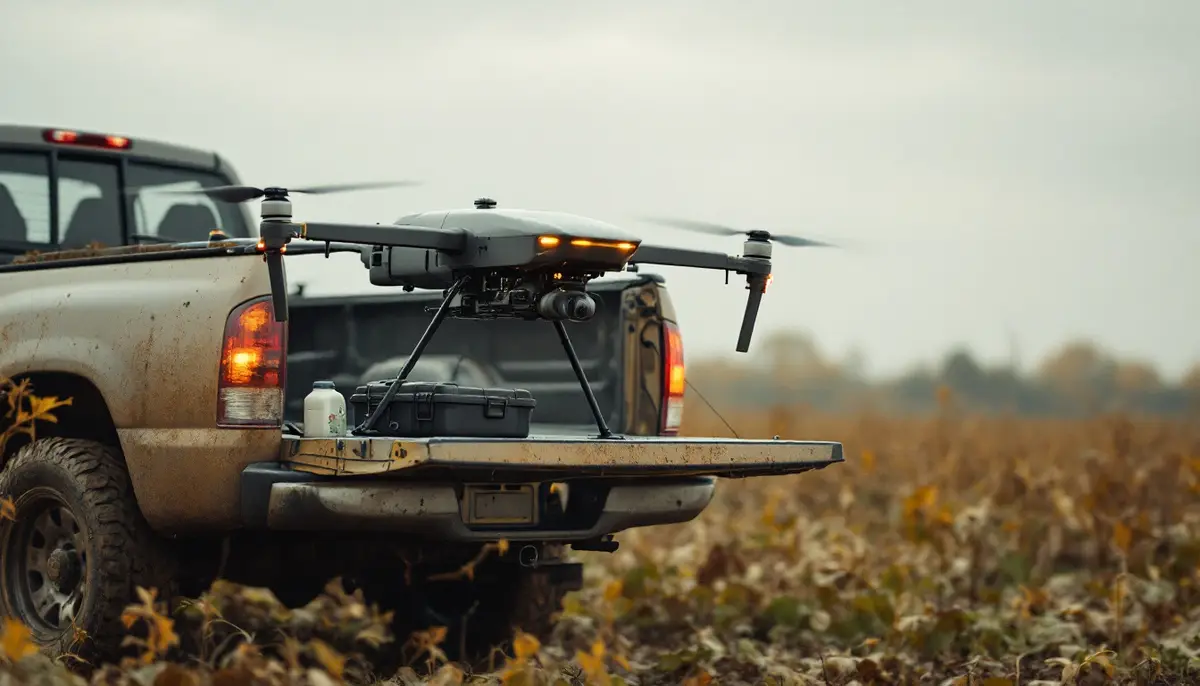
Harvest is when farm machinery gets judged. The combines roll, the grain carts shuttle back and forth, and everything that broke in July gets argued over at the co-op counter. On a growing number of farms, one of the machines up for judgment weighs less than a calf and travels in the back of a pickup: the agricultural drone.
Drones have gone from novelty to tool faster than most farm technologies. Camera drones for mapping fields became common in the 2010s. Spray drones, bigger and louder and carrying tanks of pesticide or fertilizer or hoppers of seed, followed, first in East Asia and then across the Americas. The rules for them have been written piecemeal: by aviation regulators who think about airspace, by pesticide regulators who think about drift, and by nobody in particular who thinks about the data.
The easiest way to see where the gaps are is to follow one machine through one season. The farm below is a composite, built from the kinds of operations that buy these machines in the US Midwest. It is illustrative, not a real case. The rules it runs into are real.
The farm and the pitch
Picture a family operation growing corn and soybeans on a couple of thousand acres, with a few fields of wheat. They own a ground sprayer, they hire a local aerial applicator for fungicide on tall corn, and they have the problem everyone on heavy ground knows: wet springs. When the soil is saturated, a big ground rig leaves ruts or gets stuck. When the corn is head-high in July, the rig can't go through without flattening rows, and the crop-duster is booked by half the county for the same week.
The dealer's pitch writes itself. A spray drone flies when the ground is too wet to drive on, doesn't compact soil, doesn't run over the crop, and can be in the air the afternoon a scout spots disease. It can also broadcast cover-crop seed into standing corn before harvest, a job that otherwise needs a high-clearance machine or a plane. A large spray drone with spare batteries and a generator costs a fraction of a new self-propelled sprayer, though not a small fraction.
What the pitch tends to skip is the paperwork.
Step one: becoming an aircraft operator
In the United States, a drone flown for business is an aircraft. Its pilot needs a remote pilot certificate under the Federal Aviation Administration's small-drone rule, Part 107, which took effect in 2016 and covers drones under 55 pounds at takeoff. A spray drone with a full tank is usually heavier than that, which sends the operator into a separate exemption process under section 44807 of federal aviation law.
Spraying adds another layer. Dispensing chemicals from the air counts as an "agricultural aircraft operation" under Part 137 (the same rule book that has governed crop-dusters for decades), so the farm also needs a Part 137 operator certificate, adapted for an aircraft with nobody on board. In the early 2020s the FAA turned what had been a slow, case-by-case process into something closer to a routine application, and the number of certificated drone applicators rose quickly as a result.
Then comes the pesticide side, which isn't the FAA's business at all. Whoever applies restricted-use products needs a state applicator license, usually in an aerial category, and has to follow the product label. Labels were written with ground rigs and manned aircraft in mind. How a drone fits their language on droplet size, release height, buffer zones and gallons per acre is something regulators and manufacturers have been working through product by product.
Plenty of farms skip the whole stack by hiring a custom applicator who already holds the certificates. Our illustrative farm splits the difference: it buys one machine for mapping and small jobs and hires out the big fungicide passes.
Step two: the map
Before anything gets sprayed, the drone earns its keep as a camera. A mapping flight in June produces a stitched image sharp enough to count emerged plants, plus a vegetation index from a multispectral sensor showing where the crop is under stress.
The map doesn't say why. A pale patch might be nitrogen lost after a heavy rain, compaction from last fall's grain cart, a collapsed drainage tile or the start of a disease. Someone still has to walk out and look.
Mapping is where drones are most useful and least contested. The flights are short and low, over the farmer's own land, and the main limits are the ordinary Part 107 ones: stay below 400 feet, keep the aircraft within visual line of sight, don't fly over people. The interesting questions arise later, when the images leave the farm.
Step three: the first spray day
A morning in July. The scout has found early leaf disease in a cornfield now well above head height. The drone lifts off with a tank of fungicide, follows a pre-programmed route a few meters above the canopy, and comes back every few minutes for a refill and a fresh battery. Two people and a generator stay busy at the field edge.
The advantages are real. Product goes where it's needed without wheels in the crop, and every pass is logged by satellite positioning down to the centimeter. On small, odd-shaped or waterlogged fields, the drone beats every alternative.
So are the limits. Tanks are small compared with a ground rig, so acres per hour are lower, and labels that call for higher water volumes may not match what a drone can carry. The rotor downwash that pushes droplets into the canopy also churns the air in ways that affect drift. Studies comparing drift from drones with drift from ground rigs and manned aircraft are still piling up, and their results depend heavily on wind, height, speed and nozzle choice. A good operator watches the wind and the risk of a temperature inversion the way a crop-duster pilot always has.
Here is the quiet change. Autonomous flight lowers the skill needed to get a drone into the air. It does nothing to lower the skill needed to keep product on target.
Step four: the neighbors
Across the road is an organic vegetable grower. Two fields over, a beekeeper rents space for hives. Neither has any formal say over when the drone flies.
Drift complaints are as old as aerial spraying, and the machinery for handling them (state pesticide agencies, complaint investigations, label buffers) applies to drones too. What's new is the number of potential aerial applicators. When two or three professional services did all the aerial spraying in a county, neighbors at least knew whom to call. When dozens of farms each own a drone, the old informal habit of a phone call before spraying gets harder to sustain.
Beekeepers have been arguing with the crop-protection business for a long time, as our piece on GM crops and honey showed, and they are an obvious group to watch. Voluntary registries such as FieldWatch let growers and beekeepers mark sensitive sites on a map for applicators to check. How many drone operators actually check is anyone's guess.
Step five: the data
By harvest, the drone has built a remarkable record: every field mapped several times, every spray flight logged with path, rate and product, and a season of crop-health imagery. Much of it sits in the manufacturer's app, often synced to the manufacturer's cloud.
These are the questions I raised in a piece on farm data: who can see the logs, who can pool them across thousands of farms, and whether the farmer can take them elsewhere. Drones add one more twist. In many markets, the United States among them, most agricultural drones come from Chinese manufacturers. That has turned a farm tool into a national security file.
The geopolitics in the machine shed
DJI and a handful of other Chinese firms, XAG among them, make a large share of the world's spray drones, and many US dealers built their business on them. Washington has been moving against Chinese drones on security grounds for years. The defense authorization law passed in December 2024 started a clock on a national security review of DJI, with the possibility that new models could lose the FCC equipment authorization they need to be sold. Farm groups and spray businesses spent much of 2025 lobbying and hedging, and US-made alternatives saw an opening.
For a farmer this is less abstract than it sounds. A machine chosen for its price and ease of use may become hard to repair or replace for reasons that have nothing to do with agronomy. Anyone who has read about concentration ratios in agribusiness will recognize the pattern: when one supplier dominates, a political shock to that supplier lands on everyone who depends on it.
Three other rule books
- Japan went first. Rice farmers have used small unmanned helicopters to spray paddies since the late 1980s, under industry and ministry guidelines. Multicopters later joined them.
- China built the largest fleet of farm drones anywhere, helped by machinery subsidies and a strong domestic industry. Spraying is widely sold as a service, priced by the area covered.
- The European Union took the other road. Its 2009 directive on the sustainable use of pesticides bans aerial spraying in principle, with narrow derogations, and drones count as aerial. A proposed regulation that would have opened a path for some drone spraying was voted down by the European Parliament in November 2023 and withdrawn in 2024. Exceptions exist, and steep vineyards are the classic case, where a drone is safer than a worker with a backpack sprayer on a slope. But the default answer is no. Mapping drones, meanwhile, are common.
The contrast says a lot. Japan and China treated the spray drone as a smaller, cheaper aircraft. Europe treated it as a new way to put pesticide into the air, and asked whether more of that was wanted.
What to watch
The next round of change in the US concerns flying beyond visual line of sight. The FAA proposed a framework for routine beyond-line-of-sight operations in 2025, and whatever form it finally takes will shape whether one operator can run several spray drones across large fields without a spotter at every edge. Some operators already fly small "swarms" of two or three drones under exemptions. Scale that up, and a farm drone starts to look less like a tool and more like a fleet.
Three questions are worth asking before next season:
- Who is accountable when a self-flying drone drifts? The pilot in command, the farm, the software vendor? Pesticide law assumes a person at the controls.
- Do the labels fit the machine? Rates, droplet sizes and buffers written for other equipment shouldn't be stretched to cover a drone by default.
- Where do the flight logs go? A precise record of what was sprayed where is valuable to a farmer in a drift dispute, and to anyone who can aggregate it.
This is not a case against drones. On wet ground, on small fields and on hillside vineyards, they do things no other machine does as well. It is a case for watching the distance between how fast a farm technology spreads and how fast its rules get written. For spray drones, that distance is still measured in years.

Written by Samir Haddad
Samir writes about technology and society (artificial intelligence, data, nanomaterials and digital farming) and about how new tools get governed, or not, once they leave the lab.