What does CRISPR stand for? The acronym word by word, and how the tool works
· 9 min read · by Henrik Aalto
CRISPR stands for Clustered Regularly Interspaced Short Palindromic Repeats. The name describes a pattern that microbiologists spotted in bacterial DNA years before anyone knew what it was for: a short stretch of genetic code repeated again and again, with every copy separated by a different filler sequence. The fillers turned out to be the memory of a bacterial immune system. The immune system turned out to be convertible into the gene-editing tool that now carries the name.
So, strictly speaking, the acronym describes the bacterium's filing system, not the scissors. The cutting is done by a protein, most famously Cas9, which is why scientists write "CRISPR-Cas9" when they want to be exact. The word is pronounced "crisper", like the salad drawer.
The acronym, word by word
Each word in the name is a description of what early researchers saw when they lined up the sequences.
| Word | What it describes |
|---|---|
| Clustered | The repeats sit together in one block of the genome rather than being scattered around it |
| Regularly interspaced | Between each pair of repeats is a "spacer" of fairly constant length, and every spacer is different |
| Short | Each repeat is only a few dozen DNA letters long, roughly 20 to 50 |
| Palindromic | The repeat reads, at least partly, the same on one strand as it does backwards on the other |
| Repeats | The same sequence occurs over and over, a handful of times in some microbes and dozens in others |
"Palindromic" is the word that trips people up, because DNA palindromes are not like "racecar". DNA has two strands that run in opposite directions, with G always pairing with C and A with T. Take the six letters GAATTC. The opposite strand reads CTTAAG, and because it runs the other way, you read it from the right: GAATTC again. A sequence like that, or one close to it, lets the RNA copy of a CRISPR repeat fold back on itself into a small hairpin, which matters for how the system processes it.
Laid out schematically, a CRISPR region looks like this:
leader | REPEAT | spacer 3 | REPEAT | spacer 2 | REPEAT | spacer 1 | REPEAT
The repeats are near-identical. The spacers are the interesting part.
Who named it
The repeats were first noticed in 1987 by Yoshizumi Ishino and colleagues in Osaka, who found them by accident while sequencing a gene in E. coli. They reported the oddity and moved on, since nothing explained it. Through the 1990s Francisco Mojica at the University of Alicante kept finding similar repeats in salt-loving microbes from coastal salt ponds, and then in one microbe after another.
The patterns had several clumsy names before Mojica and the Dutch researcher Ruud Jansen settled on CRISPR, which Jansen's group used in print in 2002. The same paper named the cas genes (for CRISPR-associated) that always sat next to the repeats. Everyone suspected the two were connected. Nobody yet knew how.
What the repeats are for
The answer came in 2005, when three groups independently noticed that many spacers matched the DNA of viruses that infect bacteria, known as phages. A bacterium carrying a spacer from a particular phage seemed to be immune to it. The spacers looked like mugshots.
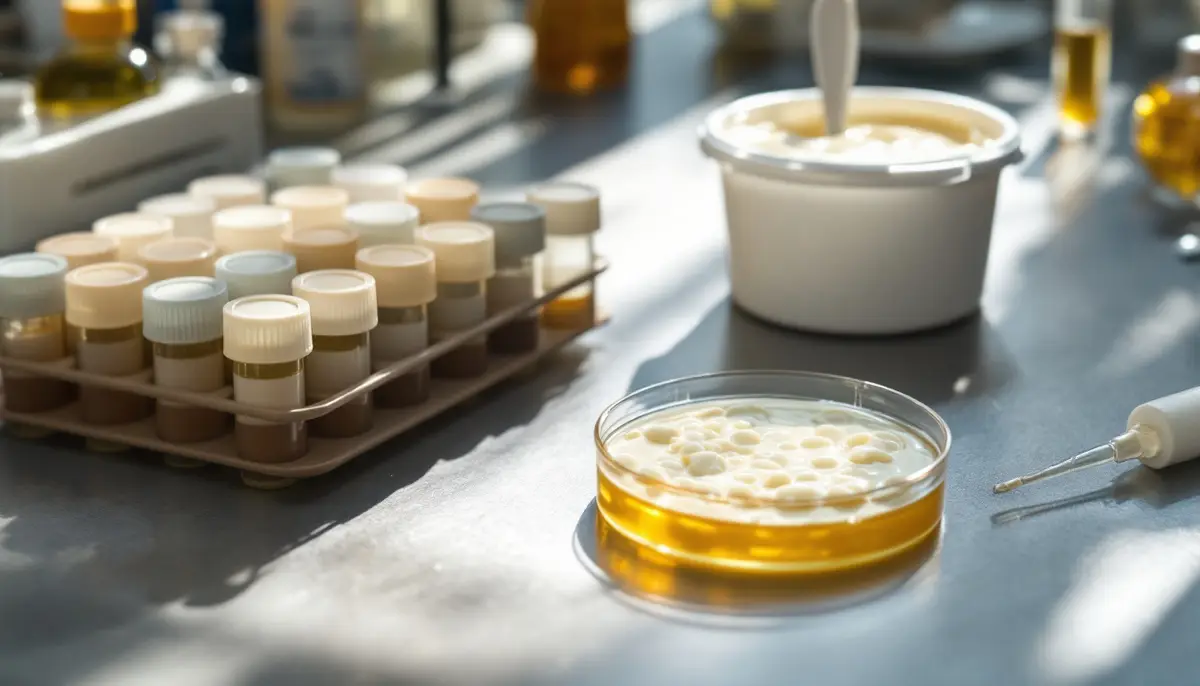
The confirmation came from the dairy industry, which loses whole batches of yogurt and cheese when phages wipe out its starter cultures. In 2007 researchers at the food company Danisco showed that Streptococcus thermophilus bacteria that survived a phage attack had added new spacers matching that phage, and that adding or removing spacers switched the resistance on and off. One of the most consequential tools in modern biology was nailed down by people trying to protect yogurt.
The defence works in three steps:
- Acquisition. When a bacterium survives an infection, Cas proteins snip a fragment of the invader's DNA and insert it as a new spacer at the front of the CRISPR array. The array becomes a chronological record, newest entries first.
- Expression. The array is copied into a long RNA molecule, which is chopped into short pieces, each carrying one spacer.
- Interference. Each piece of RNA guides a Cas protein to any DNA that matches its spacer. If the virus returns, the protein finds its genome and cuts it.
There is a neat safety catch. Cas9 only cuts if the matching sequence sits next to a short tag, called a PAM, that is present in the virus but absent from the bacterium's own spacer copies. Without it, the bacterium would shred its own memory.
From bacterial defence to editing tool
In 2012 Emmanuelle Charpentier and Jennifer Doudna, with their teams, showed that Cas9 from Streptococcus pyogenes could be programmed in a test tube to cut any DNA sequence you chose. They fused the two RNA molecules the bacterium uses into a single "guide RNA", which made the system simpler to build. A team in Vilnius, Lithuania, reported similar findings independently. Within months, in early 2013, groups led by Feng Zhang at the Broad Institute and George Church at Harvard showed it working in human and mouse cells. Charpentier and Doudna shared the 2020 Nobel Prize in Chemistry; the patent fight between the University of California and the Broad Institute went on far longer.
What made it revolutionary was not cutting DNA, which earlier tools could do. It was the ease of aiming. Older methods required engineering a new protein for every target, a project of months. With CRISPR you change about 20 letters of the guide RNA, a job of days.
How editing works inside a cell
The guide RNA leads Cas9 to a 20-letter match next to a PAM, and Cas9 cuts both strands of the DNA. That is all it does. The editing is done by the cell, which treats a double-strand break as an emergency and repairs it in one of two ways:
- Gluing the ends back together. Fast and sloppy, this often adds or deletes a few letters, which usually breaks the gene. It is how researchers switch genes off.
- Copying from a template. If a piece of DNA carrying the desired change is supplied, the cell can use it to rebuild the cut site precisely. This is less efficient, especially in cells that are not dividing.
CRISPR, in other words, is less a word processor than a pair of scissors with very good aim, and the cell holds the pen. The scissors also sometimes cut similar sequences elsewhere in the genome, or leave larger scars than intended, which is why so much effort goes into checking edits.
Once an edit is in a plant or animal, it is inherited like any other version of a gene: an organism carrying it on one chromosome passes it to about half its offspring, which you can model in our Punnett square calculator. The exception is the gene drive, a CRISPR construct built to copy itself onto the partner chromosome and break that coin flip, which I discussed in gene drives: the case for caution and the case for trying.
Base editing and prime editing
Cutting both strands is a blunt act, so newer tools avoid it.
| Tool | What it does | Cuts both strands? | Typical use |
|---|---|---|---|
| Cas9 nuclease | Cuts at the target; the cell repairs | Yes | Switching genes off |
| Base editor | Chemically converts one DNA letter into another | No | Correcting a single-letter mutation |
| Prime editor | Writes a short new sequence at the target | No | Small, precise fixes and insertions |
Base editors, developed in David Liu's laboratory at the Broad Institute from 2016, pair a disabled or nicking version of Cas9 with an enzyme that changes one letter chemically, C to T or A to G. Prime editing, from the same lab in 2019, pairs a nicking Cas9 with an enzyme that copies RNA into DNA, so that an extended guide can carry a template for the new sequence. It can make any single-letter swap and small insertions or deletions. Both reduce the unwanted damage that double-strand breaks cause. The trade-off is bigger molecular machinery, which is harder to deliver into cells.
The first approved CRISPR medicine
In November 2023 the UK's medicines regulator approved Casgevy, from Vertex Pharmaceuticals and CRISPR Therapeutics, for sickle cell disease and beta thalassaemia, the first approval of a CRISPR therapy anywhere. The US Food and Drug Administration followed for sickle cell disease in December 2023 and for beta thalassaemia shortly afterwards.
The treatment does not edit the faulty haemoglobin gene itself. Doctors collect a patient's blood stem cells, and in the laboratory Cas9 disables a genetic switch that normally turns off fetal haemoglobin after birth. The patient receives chemotherapy to clear the bone marrow, then gets the edited cells back. Their red blood cells start making fetal haemoglobin again, which compensates for the defective adult form. In the clinical trials most patients with sickle cell disease were free of severe pain crises for at least a year.
It is also demanding: high-dose chemotherapy, long hospital stays, a small number of qualified centres and a cost in the millions per patient. Since then the field has pushed towards editing inside the body and towards bespoke treatments; in 2025 doctors in Philadelphia reported treating a baby with a rare metabolic disease using a base editor designed for his particular mutation. Anyone weighing a treatment like this needs specialist medical advice, not a blog.
Crops, embryos and the rules
In agriculture, the first CRISPR-edited food went on sale in Japan in 2021: a tomato bred to contain more of the compound GABA. Many countries, including the US, Japan, Argentina and, since its 2023 Precision Breeding Act, England, treat small edits that leave no foreign DNA more lightly than conventional GMOs. The EU has spent years negotiating a two-tier regime, the subject of my piece on what the European Parliament voted for on gene-edited plants.
Human embryos are a different matter. In 2018 the Chinese researcher He Jiankui announced the birth of twin girls whose embryos he had edited; he was widely condemned and sentenced to prison in China the following year. Editing that would pass to future generations remains off limits in clinics almost everywhere.
FAQ
What does Cas9 stand for? CRISPR-associated protein 9. The number comes from the catalogue of cas genes, not from any ranking.
Is CRISPR an acronym or a word? An acronym, usually written in capitals, though in conversation it is treated as a noun ("using CRISPR") and even a verb.
Is CRISPR the same as genetic modification? It is a way of modifying genes, but whether an edited organism counts as a "GMO" depends on the law where you are. Many edited plants contain no foreign DNA, which is why regulators disagree.
Who discovered CRISPR? No single person. Ishino's group saw the repeats in 1987, Mojica named them and helped work out their purpose, the Danisco team proved the immune function, and Charpentier and Doudna turned it into a programmable tool.
Further reading
For the people and the patent fight, Walter Isaacson's biography of Doudna is the accessible version; for the science and the ethics in Doudna's own voice, read her book with Samuel Sternberg. Both appear, with six other titles, in our list of popular science books on genetics.

Written by Henrik Aalto
Henrik writes about genetic engineering, gene editing and synthetic biology: the science, the patents and the gap between a press release and a product. He reads the supplementary data so you do not have to.