Vertical farming, fifteen years on: what the towers actually grew
· 7 min read · by Marisol Ortega
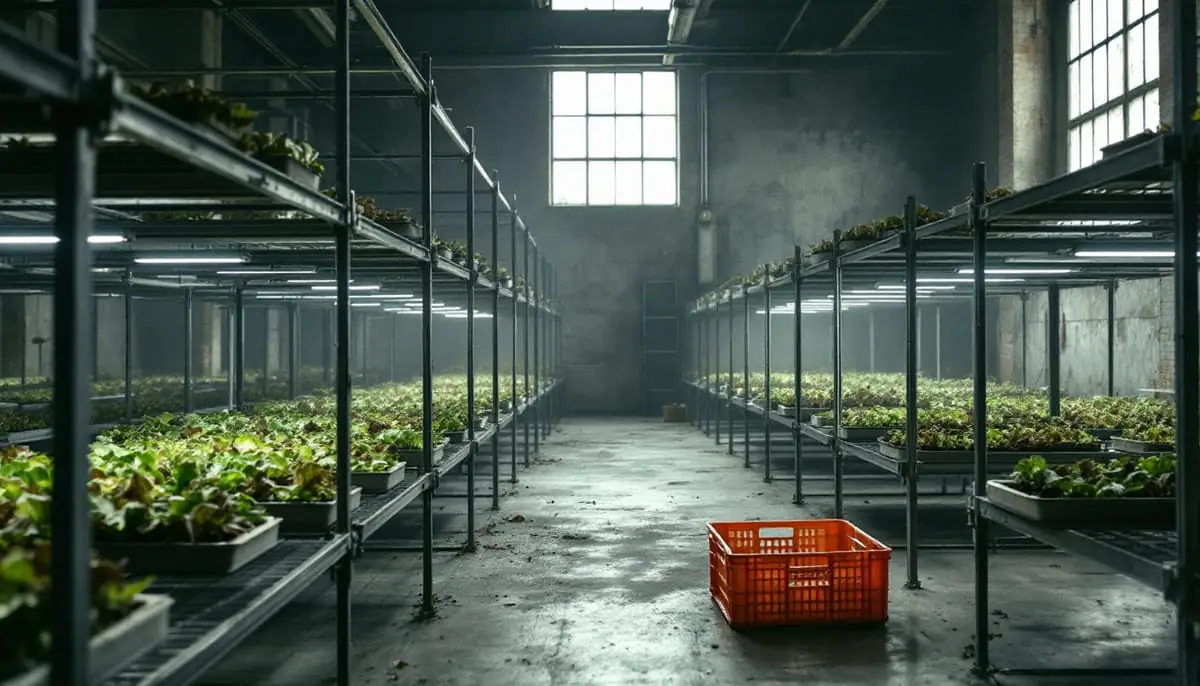
Somewhere in a supermarket chiller near you there is probably a plastic clamshell of salad leaves that has never seen the sun. It was grown on stacked shelves under pinkish LED light, in a warehouse on the edge of a city, and it costs a little more than lettuce from a field. That clamshell is most of what remains, in early 2024, of one of the boldest food ideas of the last generation.
The pitch: a farm thirty stories high
The vertical farm as a public idea belongs mostly to Dickson Despommier, a microbiologist and public-health professor at Columbia University. It started as a class exercise with his students around the turn of the millennium, reached a wide audience in the late 2000s and became a book, The Vertical Farm, in 2010. The picture was striking. Glass towers in the middle of cities, every floor a climate-controlled growing room, crops fed by nutrient mists and lit by lamps, water cycled through fish tanks, waste turned into energy. A single tower on one city block, the argument went, could feed tens of thousands of people.
The reasoning sounded tidy. More than half of humanity lives in cities, so bring the food to them. Indoor crops face no drought, no frost, no pests drifting over from the neighbor's field. Food miles shrink. And the land freed from farming could go back to forest.
That last part is where many people who work with farmers stopped nodding. The pitch was not only about adding food production to cities. It was about subtracting it from the countryside. Supporters called vertical farming a "third green revolution", a phrase that reassures nobody who watched the first one tie farmers to bought seed, fertilizer and debt. Asked what would become of the people left on the land, the idea's best-known champion suggested in a magazine interview that they could be paid to look after trees and carbon. Countries such as Mali, which sits on one of Africa's great rivers and has fed itself in many years, were described as places with nothing at all. Critics at the time called this a colonial way of looking at land, and it is hard to argue with them.
What actually got built
The skyscrapers never came. Dongtan, the eco-city planned near Shanghai that was meant to host one of the first, never got far beyond the drawing board. What appeared instead, through the 2010s, was more modest and more industrial: converted warehouses and factories, shipping containers fitted with racks and lights, and glass-fronted growing cabinets inside supermarkets. Japan had been running "plant factories" for years. In the United States, Europe and the Gulf states, startups took the same basic hydroponics and sold it as a technology business.
That framing is what brought the money. Investors who had never owned a hoe were told that indoor agriculture was a hardware-and-software play: control every variable, collect every data point, scale like a tech company. In 2017 SoftBank's Vision Fund led a $200 million investment in Plenty, a California startup, with Jeff Bezos's personal investment firm also taking part. AeroFarms in New Jersey, Bowery in New York and Berlin's Infarm raised large sums. Funding for the sector peaked around 2020 and 2021, when cheap capital and pandemic worries about supply chains made "local, resilient food" an easy sell. Several companies listed on the stock market through special purpose acquisition companies, the blank-check vehicles that were briefly fashionable.
The reckoning, 2022–2023
Then money got expensive, and electricity got more so. After Russia invaded Ukraine in February 2022, European energy prices jumped and interest rates rose almost everywhere. For a business that buys all its light from the grid and borrows to build, both shocks landed at once.
The list of casualties grew quickly:
- Fifth Season, a vertical farm in Pittsburgh, shut down in late 2022.
- Infarm, whose in-store cabinets had spread across Europe, cut hundreds of jobs from late 2022 and pulled out of most of its markets during 2023.
- Kalera, which had gone public in 2022, filed for bankruptcy in the spring of 2023.
- AeroFarms, for years the sector's poster child, filed for Chapter 11 protection in June 2023 to restructure.
- AppHarvest, which grew tomatoes in huge high-tech greenhouses in Kentucky rather than in stacked racks, filed for bankruptcy in July 2023, a sign that the wider bet on "controlled environment" farming was in trouble too.
Others survived by cutting staff, delaying new sites or turning to selling their technology to someone else. None of this means every indoor farm failed. It means the promise of a new way to feed cities met a balance sheet, and the balance sheet won.
The physics no pitch deck could fix
The deeper problem was never management. It was sunlight.
A field or a greenhouse gets its light for nothing. An indoor farm has to buy every photon, turn electricity into light with LEDs that have improved a great deal but cannot be perfect, and then spend more electricity removing the heat those lights give off. Add urban rents and the labor of tending racks several meters high, and the cost per kilo stays stubbornly high.
That cost decides what can be grown. The crops that work indoors are light, fast, sell for a lot per kilo and are eaten mostly as leaves: lettuce, baby greens, basil and other herbs, microgreens. A few companies grow strawberries and sell them as luxury fruit; Oishii in New Jersey built its brand on that. Nobody has a business case for growing wheat, rice, maize, beans or potatoes under lamps, and those are the crops that actually feed people. A tower full of salad does not feed a city. It garnishes the city's plate.
The food-miles argument turned out to be thin as well. For most foods, transport is a small part of total emissions compared with what happens on the farm and in land use, so shaving a few hundred kilometers off a lettuce's journey matters less than how the power for its lights is generated. The water savings are real, but they matter most in dry places, and dry places rarely come with the cheap, clean electricity these farms need.
What urban growing that works looks like
None of this is an argument against growing food in cities. It is an argument for growing it the way that has always worked: with the sun, with soil and compost, and with a purpose beyond the next funding round.
Look at the city farms that have lasted:
- Rooftop soil farms, such as Brooklyn Grange in New York, which has grown vegetables on roofs since 2010 and sells to neighbors and restaurants alongside running education programs.
- Rooftop greenhouses, like those of Lufa Farms in Montreal, which use glass and daylight on top of commercial buildings instead of stacked racks under lamps.
- Havana's organopónicos, raised beds of compost and soil built on vacant lots after the collapse of Soviet trade in the early 1990s left Cuba short of fuel, fertilizer and imported food. They became a lasting part of how the city eats.
- Rosario's community gardens in Argentina, where the city began backing food plots on unused land after the economic crisis of 2001–2002, giving families both vegetables and a small income from market stalls.
- The plain allotment, schoolyard bed and balcony, which never raised a cent of venture capital and never needed to.
What these share is not technology but modesty. They use cheap inputs and free light, and they treat the grower as a participant rather than a machine operator. They give people fresh food, a reason to meet their neighbors and sometimes a living. They do not claim to replace farming in the countryside. They sit beside it.
There is room for some indoor growing in that picture. A greenhouse warmed by a factory's waste heat, a container of herbs and greens in a remote northern community where fresh produce is flown in at great cost, a research facility testing varieties: these make sense on their own terms. The trouble starts when a niche is sold as the future of all food.
The land was never empty
The most revealing part of the 2009 vision was not the LEDs. It was the assumption that land outside cities is underused and that its farmers are in the way. Fifteen years on, that assumption is still with us in other clothes: carbon offsets, biofuel plantations, rewilding plans drawn up far from the people who live on the land. Those threads will run through a good deal of what this blog covers under food and farming and technology and society, and the reading list gathers some useful places to start.
The countryside was never empty. It is full of people growing most of the world's food on ordinary soil under an ordinary sky, often with very little help. The best use of a city's flat roofs is to grow tomatoes and beans on some of them, and to remember who grows the rest.

Written by Marisol Ortega
Marisol covers seeds, smallholder farming and the rules that decide who may save, swap or sell them. She has spent a long time around maize fields and seed fairs and still thinks maize is the most political plant there is.