Agroecology on the farm: what changes, season by season
· 7 min read · by Marisol Ortega
Agroecology has climbed a long way up the ladder of official language. It appears in UN strategies, national food plans, development bank reports and, increasingly, in the sustainability pages of companies that sell the very inputs it tries to reduce. Up there the word can mean almost anything.
Down on a farm it means something plainer. It means looking at a field as a set of relationships among soil, plants, insects, animals, water and people, and then managing those relationships so that the farm needs less from outside and keeps more of what it produces. It is a practice before it is a policy. This piece stays mostly at ground level.
What actually changes on the farm
More kinds of plants, in more places
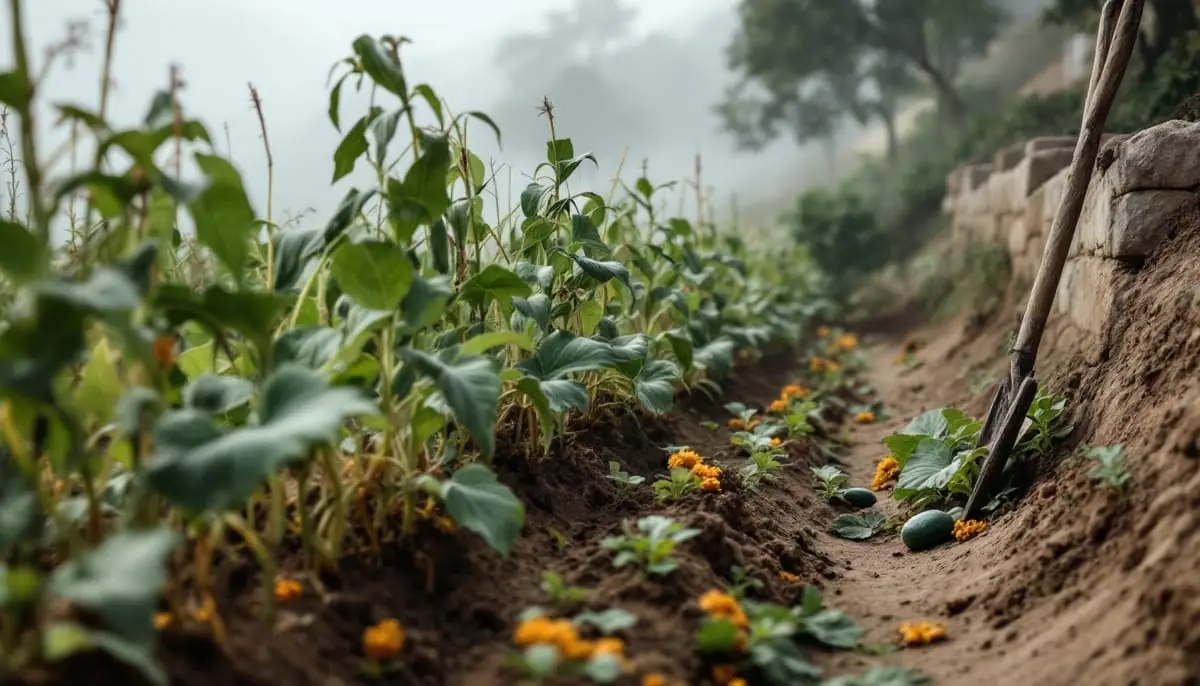
The first visible change is diversity. A field of one crop becomes a field of several: maize with climbing beans and squash in the old milpa pattern, vegetables intercropped with flowers that draw in predatory insects, coffee grown under shade trees, hedgerows and live fences where there were bare boundaries. In East Africa the push-pull system plants desmodium between maize rows to repel stemborer moths and suppress the parasitic weed striga, with a border of Napier grass to lure the moths away. Each added species does a job.
Rotations and living cover
Fields that grew the same crop year after year start rotating, which breaks pest and disease cycles. Bare soil between seasons gets covered with a green manure or a cover crop. In Central America, hillside farmers have long grown velvet bean in their maize plots to smother weeds, protect the soil and add nitrogen.
Feeding the soil
Crop residues stay on the field instead of being burned. Manure, compost and mulch go back into the ground. On slopes, contour barriers of grass or stone hold the soil in place. The aim is more organic matter over time, with all the benefits for structure, water and fertility that come with it, as the earlier guide to what soil carbon can and cannot promise explains.
Local seed
Farmers rely more on seed they select and save themselves, swap with neighbors or find at seed fairs, especially for crops where local varieties are well adapted. That does not rule out buying improved varieties when they help, but it changes the default. It also runs straight into seed law, and the rules shaped by UPOV 91 decide how freely that seed can move.
Fewer bought inputs
As the farm's own processes take on more of the work, purchases of synthetic fertilizer, herbicides and insecticides fall. Sometimes they fall to zero; often they become targeted, used when a problem demands it rather than on a calendar. Money that used to leave the farm at planting time stays in the household.
The FAO's ten elements, in plain words
After a series of meetings that began with its first agroecology symposium in 2014, the FAO drew up ten elements of agroecology in 2018, and its governing council approved them in December 2019. That shift is part of a longer story about who the FAO listens to. The language of the official version is formal. Here is a farmer's translation:
- Diversity. Grow and raise many things, not one.
- Co-creation and sharing of knowledge. Farmers learn best from other farmers, and researchers should learn from them too.
- Synergies. Arrange things so they help each other: legumes feeding maize, chickens eating pests, trees shading coffee.
- Efficiency. Get more out of what you already have before buying more.
- Recycling. Close the loops: residues to compost, manure to fields, water used twice.
- Resilience. Build a farm that can take a drought, a pest outbreak or a price crash without collapsing.
- Human and social values. Dignity, fairness and decent livelihoods, including for women and young people.
- Culture and food traditions. Grow food people actually want to eat, and keep the knowledge that goes with it.
- Responsible governance. Fair access to land, water and seed, and rules made with the people they affect.
- Circular and solidarity economy. Shorter chains between farmer and eater, and markets that pay producers fairly.
The last four are the ones that make agroecology political, and the ones most often left out when the word is borrowed for a corporate report. The High Level Panel of Experts that advises the UN Committee on World Food Security added its own list of thirteen principles in 2019, covering much the same ground.
A composite farm, year by year
The farm below is not a real place. It is a composite, assembled from patterns that recur across many smallholdings in maize-growing hill regions of Mexico and Central America. Real farms vary enormously, and the timings here are illustrative only.
Before. A family works about three hectares on a slope. Most of it is planted to hybrid maize, with seed bought every year on credit along with fertilizer and herbicide. Beans have dropped out of the field because the herbicide kills them. The topsoil is thin and washes downhill in heavy rains. In a good year the harvest pays off the debt with a little left over. In a bad year it doesn't.
Year one. The family digs contour ditches and plants grass strips along them on the steepest part. They return beans to part of the maize, using seed from a neighbor, and plant squash in the gaps. They stop burning residues. Chicken manure and kitchen scraps start going onto a compost heap. Maize yields on the converted plot hold roughly steady or dip a little. Labor goes up, mostly for weeding by hand.
Year two. Velvet bean goes in after the maize on one plot as a green manure. A brother-in-law who has done it before comes over to show them how; this is how the Campesino a Campesino movement has spread such methods across Central America for decades. The family plants a few fruit trees along the boundaries. They buy less herbicide and less fertilizer. Weeding is still the hardest part of the year.
Years three and four. The soil on the oldest plots starts to look and feel different, darker and easier to work. The velvet bean has knocked back the weeds. Maize on the improved plots is doing as well as before or better, with far less bought fertilizer. Beans and squash feed the family and some go to the local market. The chickens are laying, and eggs bring in a small weekly income. The family borrows less at planting time.
Year five. The farm looks untidy to an agronomist trained on monocultures and orderly to anyone who knows how to read it. Cash income is not necessarily higher. Costs are lower, the family eats better, the soil is staying on the hill, and a dry spell is worrying rather than catastrophic.
Nothing in that story is guaranteed. Some families stall at year two. Some never see yields recover on very degraded land without help. But the pattern of the first few years, with heavier labor and uncertain yields before the benefits show, is common enough that anyone promoting agroecology should say so up front.
The honest trade-offs
Labor
The biggest one. Herbicides save labor, and replacing them with hand weeding, mulching and managing several crops at once takes more of it, at least at first. That work often falls on women and children unless the household deliberately shares it out. Where young people have left for the city, labor is the hard limit.
The transition years
Soil biology takes time to rebuild, pest predators take time to return, and farmers take time to learn. Meta-analyses comparing organic and conventional systems find lower yields on average, with very large differences by crop, place and management, and the gap is often widest in the first years. A family living close to the edge may not be able to absorb even one bad season. Credit, seed support and public programs that carry farmers through the transition make an enormous difference.
Markets
A diverse farm produces small amounts of many things, while buyers and middlemen want large volumes of one uniform product. Local markets, cooperatives and public purchasing help. Brazil's school meals law of 2009, which requires at least 30 percent of federal school-meal funds to be spent on food from family farms, is a well-known example. Participatory guarantee systems, in which farmers and consumers certify each other's produce, can stand in for expensive third-party organic certification.
Land, credit and policy
Investing in soil only pays if you will still be farming the same land in five years, so insecure tenure undermines everything. Credit is often tied to a package of bought seed and chemicals. Many governments still spend far more on fertilizer subsidies than on extension services that teach agroecological methods. And sometimes very degraded or acid soils need some outside help, such as lime or phosphorus, before organic matter can start building at all. Admitting that is not a betrayal of the idea.
None of these trade-offs is a reason to stop. They are reasons to stop pretending that agroecology is either a miracle or a nostalgic fantasy. It is a demanding way to farm that tends to pay off over time, works best when farmers share what they know, and depends heavily on whether policy is pulling with it or against it. Farmers have carried most of the risk of that transition so far. A fair food system would share more of it.

Written by Marisol Ortega
Marisol covers seeds, smallholder farming and the rules that decide who may save, swap or sell them. She has spent a long time around maize fields and seed fairs and still thinks maize is the most political plant there is.