Titanium dioxide: where it comes from, and why Europe took it out of food
· 9 min read · by Samir Haddad
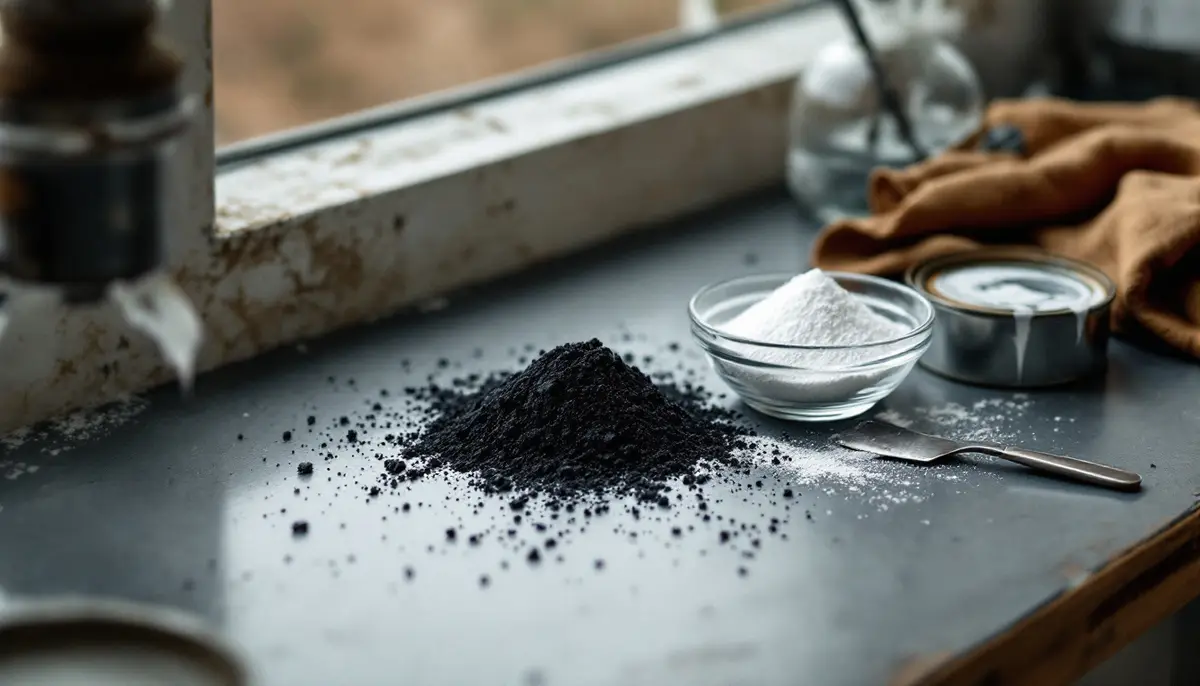
Titanium dioxide is the most widely used white pigment in the world: a compound of titanium and oxygen that makes paint opaque, plastics bright, mineral sunscreen protective and, until 2022 in Europe, the shells of sugar-coated sweets gleaming white. It comes out of the ground. Miners extract titanium-bearing minerals, mainly ilmenite and rutile, from heavy mineral sands and hard-rock deposits, and chemical plants strip away the iron and other impurities until what remains is an intensely white powder.
In food it went by the code E171. The European Union banned it as a food additive in 2022, after its food safety authority said it could no longer rule out that the smallest particles might damage DNA. The United States, Canada and Great Britain still allow it, and paint, sunscreen and other uses carry on under different rules.
Where does titanium dioxide come from?
Titanium is common in the Earth's crust but thinly spread, and only a few minerals hold enough of it to be worth mining.
The ores
Ilmenite, an oxide of iron and titanium, is the workhorse. It is black, and there is far more of it than of anything else. Rutile is already almost pure titanium dioxide, which makes it scarcer and more valuable. Both are dense minerals that erosion frees from their parent rock and that rivers, waves and wind then sort and concentrate, which is why so much of the world's supply comes from old beach and dune sands.
Mining them means dredging or digging the sand, then separating the heavy minerals from quartz and from each other. Coastal operations of this kind run in Australia, South Africa, Mozambique, Senegal, Madagascar and Sierra Leone. China, which makes more titanium dioxide pigment than any other country, also draws titanium from hard-rock iron and titanium ores, as do mines in Canada and Norway.
Mineral sand mining reworks coastal land on a large scale, and some projects, such as the big ilmenite operation in southeastern Madagascar, have faced long disputes with neighbors over land and water.
From black sand to white powder
Ilmenite is black. Turning it into a white pigment takes one of two chemical routes.
- The sulfate process, the older of the two, dissolves ilmenite or titanium-rich slag in sulfuric acid, precipitates the titanium as a hydrated oxide and roasts it in a kiln. It can make either of the two main crystal forms, anatase or rutile, and it leaves large volumes of iron sulfate and spent acid to treat, sell or dispose of.
- The chloride process, developed by DuPont in the mid-twentieth century, reacts richer feedstock with chlorine and coke to make titanium tetrachloride, a liquid that can be purified by distillation. Burning that liquid in oxygen gives titanium dioxide and frees the chlorine for reuse. It produces less waste per tonne but needs higher-grade ore, which is why low-grade ilmenite is often first upgraded into slag or "synthetic rutile".
Most titanium ore never becomes metal. The large majority goes into pigment; the titanium in aircraft frames and hip replacements is a much smaller stream. Pigment making is also a concentrated business. A handful of Western firms, including Chemours (spun off from DuPont), Tronox and Kronos, compete with fast-growing Chinese producers, whose exports have grown enough that the EU has imposed anti-dumping duties on titanium dioxide from China.
Why it is so white
The whiteness is physics. Titanium dioxide bends light more strongly than almost any other common material; its refractive index is higher than diamond's. Particles of the right size, a few hundred nanometers or roughly half the wavelength of visible light, scatter that light in every direction instead of letting it pass, so a thin layer looks solid white.
That target has a side effect at the center of the food story. Precipitation and milling never produce particles of exactly one size. A pigment built around 200 to 300 nanometers also contains a tail of smaller particles, some below 100 nanometers, the conventional cutoff for a nanomaterial. Make the particles small on purpose, as sunscreen makers do, and they stop scattering visible light and turn almost transparent while still blocking ultraviolet.
There is a historical irony too. Titanium white came into commercial use in the early twentieth century and gradually displaced lead white, the standard white in paint for centuries and a well-known poison. Titanium dioxide arrived as the safe replacement.
Where titanium dioxide ends up
| Use | What it does | Typical particles | Rules in brief |
|---|---|---|---|
| Paint and coatings | Opacity and brightness | Pigment grade, a few hundred nm | The largest single use |
| Plastics, paper, cosmetics, toothpaste | Whiteness and opacity | Pigment grade, some nano in cosmetics | General chemicals and cosmetics rules |
| Sunscreen | Blocks ultraviolet light | Often nano, under 100 nm, so it rubs in clear | Approved UV filter in the US and EU; the EU bars nano forms in products that could be inhaled |
| Medicines | Coats tablets and capsules, shields contents from light | Pigment grade | Exempted from the EU food ban; its use in medicines was left for later review |
| Food (E171) | Bright white or opaque finish | Pigment grade, with a nano fraction | Banned in EU food since August 2022; allowed in the US up to 1 percent of a food's weight |
Titanium dioxide in food
In food, titanium dioxide does one job: it makes things look white or opaque. Its best-known role was the hard white shell on sugar-coated sweets and chewing gum, but it also turned up in icings, marshmallows, some sauces and dressings, and coffee whiteners. It adds no flavor and no nutrition. Food is a small slice of total demand, which helps explain why European manufacturers reformulated, often with calcium carbonate or starch-based whiteners, without much disruption once they had to.
Why the EU banned E171
A 2017 study by French government researchers reported precancerous changes in the colons of some rats given E171 in their drinking water. France suspended the additive from January 2020. In May 2021 the European Food Safety Authority (EFSA) concluded that E171 could no longer be considered safe as a food additive. Concerns about genotoxicity, meaning damage to genetic material, could not be ruled out, particularly for the nano fraction, and without excluding that, EFSA could not set a safe daily intake. The European Commission adopted the ban in January 2022, and it took full effect in August 2022 after a six-month phase-out. We covered that sequence, and the wider story of nanomaterials in food and packaging, in 2024.
Two points are easy to lose. EFSA did not find that titanium dioxide causes cancer in people. It found that it could not show the additive was safe, which under EU food law is enough to end an approval. That rule puts the burden on the substance: an unresolved question counts against it. Where regulators must demonstrate harm before acting, the same open question leaves the product on the shelf. Europe's long argument over how to regulate gene-edited plants turns on the same issue of who has to prove what.
The United States and elsewhere
The US Food and Drug Administration has allowed titanium dioxide as a color additive since the 1960s, at up to 1 percent of a food's weight, and it did not follow Europe in 2022. In 2023 a coalition of consumer and environmental groups petitioned the agency to revoke that approval. California's 2023 law banning several food additives had titanium dioxide in early drafts and dropped it before passage. US food-additive policy has kept shifting at state and federal level since then, so American readers should check the FDA's own pages for its current position.
Health Canada reviewed the science in 2022, found no conclusive evidence that food-grade titanium dioxide is a concern for human health, and did not restrict it. Great Britain, advised by its own experts, also kept it permitted, while Northern Ireland, which follows EU food additive rules, applies the ban.
Breathing it, wearing it
Outside food, the main health question about titanium dioxide is inhaling it, not eating it. In 2006 the International Agency for Research on Cancer classified it as possibly carcinogenic to humans (Group 2B), mainly on the basis of lung tumors in rats that breathed high concentrations of fine dust; the evidence from studies of workers was judged inadequate. That is about workplace dust, not painted walls. An EU classification of certain titanium dioxide powders as suspected carcinogens by inhalation, adopted in 2019, was annulled by the EU's General Court in 2022, which found a manifest error in how the key study behind it had been assessed.
Sunscreen raises its own version of the nano question. Mineral sunscreens rely on titanium dioxide and zinc oxide, often in nano form so they don't leave a white film. In 2019 the FDA proposed that these two be the only sunscreen filters treated as generally recognized as safe and effective. European scientific advisers have concluded that nano titanium dioxide does not get through healthy, intact skin in meaningful amounts, and the EU allows it in sunscreens but not in sprays. Health agencies continue to recommend sun protection; the debate is about formulation, not about whether to use it.
What is still uncertain
- Effects at real dietary doses. The animal studies that raised concern used doses and exposure routes that are hard to translate to people eating small amounts over decades.
- What happens after swallowing. Only a small fraction appears to be absorbed. Whether it builds up in tissues, or affects the gut lining and microbiome as some animal work suggests, is poorly measured in humans.
- Measurement. Counting nanoparticles inside a sweet, a sauce or a tablet is far harder than in a clean powder, which limits research and enforcement alike.
- Who eats the most. EFSA's exposure estimates were higher for children than adults, because children eat more sweets relative to body weight.
FAQ
Is titanium dioxide safe to eat?
Regulators disagree. EFSA concluded in 2021 that it could not confirm E171 was safe, mainly because genotoxicity could not be ruled out, and the EU removed it from food. The FDA, Health Canada and Great Britain's regulators continue to permit it. No regulator has concluded that eating it causes cancer in people. For questions about your own diet, a doctor or registered dietitian is the right person to ask.
How can I tell if a product contains it?
In the EU it should no longer appear in food. In the US it may be listed as "titanium dioxide" or, because it is a color additive exempt from batch certification, under a general term such as "color added" or "artificial color". If the label is unclear, the manufacturer can tell you.
Is titanium dioxide the same as titanium metal?
No. The oxide is a white powder; the metal is a structural material. They share a starting point, though: the titanium tetrachloride made in the chloride process is also the raw material for titanium metal, which is produced by reducing it with magnesium.
An old material, a new question
Titanium dioxide was in sweets for decades before anyone looked closely at its smallest particles. That is less a scandal than a description of how most chemical oversight works: approve once, review rarely, look hard only when a study forces it. Asking about particle size and real-world exposure before a material is everywhere is part of the case for standing public technology assessment. An old pigment with a nano problem nobody designed shows why that question belongs at the start.

Written by Samir Haddad
Samir writes about technology and society (artificial intelligence, data, nanomaterials and digital farming) and about how new tools get governed, or not, once they leave the lab.