UPOV 91 and seed laws, explained from the ground up
· 9 min read · by Marisol Ortega
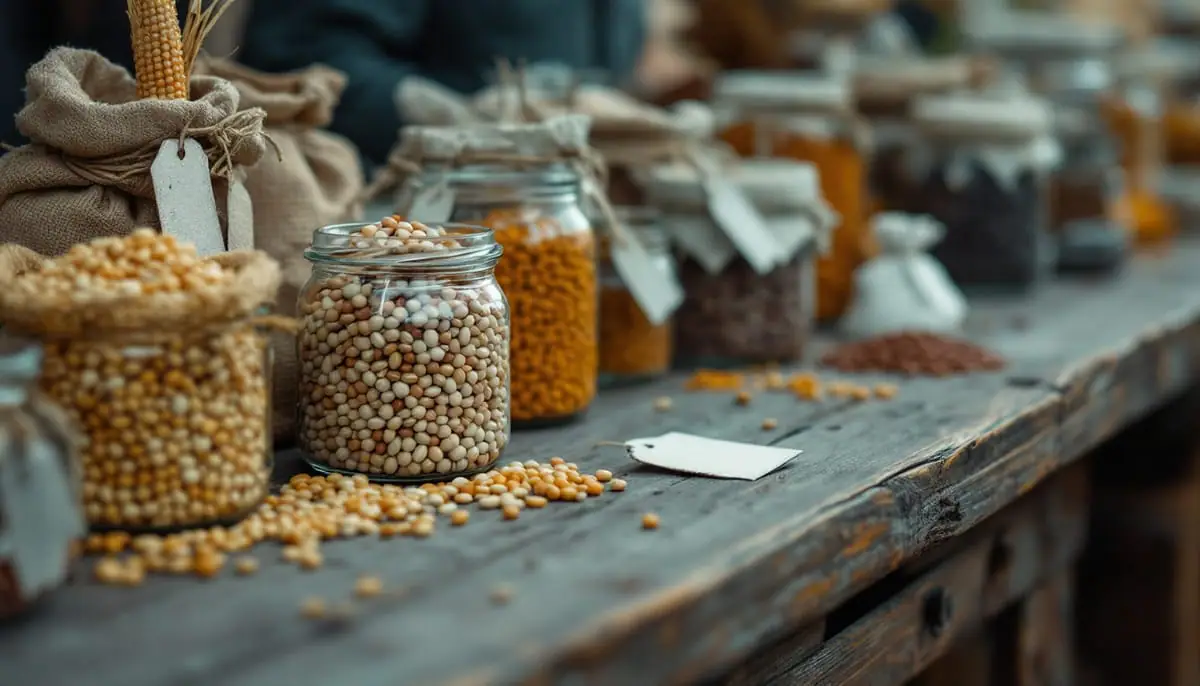
Picture a seed fair in a small town square. Trestle tables, jars and cloth bags, beans in a dozen colors, maize ears tied in bunches by their husks, a squash someone's grandmother brought from the next valley. Nobody at those tables has registered anything. Most of them have never heard of a treaty revised in Geneva in 1991. Yet that treaty, and the national laws written to match it, increasingly decide what may happen at tables like these.
This is a guide to UPOV 91 for people who care about seed rather than for lawyers. Every country's law differs in the details, but the broad shape is similar almost everywhere.
What UPOV is
UPOV is the French acronym for the International Union for the Protection of New Varieties of Plants, an intergovernmental organization based in Geneva. Its founding convention of 1961 was revised in 1972, 1978 and 1991, and two versions still matter: the 1978 Act and the 1991 Act. The 1978 Act has long been closed to newcomers, so countries joining today sign up to the 1991 version. The union has close to 80 members, counting the European Union and the African Intellectual Property Organization (OAPI), which belong as blocs.
The system it sets up, plant variety protection or plant breeders' rights, is a form of intellectual property built specifically for plant varieties.
What a breeder's right protects
To be protected, a variety has to pass four tests. It must be new, meaning not sold commercially for longer than a set period. It must be distinct from any other known variety, uniform (the plants look and behave alike) and stable (they stay that way generation after generation). The last three are known together as DUS.
Pause on uniformity. A farmer's variety selected over generations in one community is usually diverse on purpose, a mix of plant types that spreads risk across wet years and dry ones. That diversity is its strength in the field and its weakness in the law. Farmer varieties rarely meet DUS standards, so they generally cannot be protected under UPOV. Commercial varieties can. The system was designed around the needs of professional breeders, and it shows.
1978 versus 1991: what changed
The 1991 revision tightened almost everything:
| Issue | UPOV 1978 | UPOV 1991 |
|---|---|---|
| Species covered | A list that grows over time | Eventually all plant genera and species |
| What needs the breeder's permission | Producing seed for commercial marketing, offering it for sale, marketing it | Producing or reproducing, conditioning, offering, selling, exporting, importing and stocking propagating material |
| The harvested crop | Generally outside the right | Can be covered if the seed was used without permission |
| Saving seed on the farm | Not addressed; in practice left alone | An optional exception, "within reasonable limits", for replanting on the farmer's own holding |
| Breeding from a protected variety | Allowed | Allowed, but "essentially derived" varieties stay under the first breeder's control |
| Minimum term | 15 years (18 for trees and vines) | 20 years (25 for trees and vines) |
| Patent and breeder's right on the same species | Not allowed, with a narrow exception | Allowed |
For farmers, the fourth row is the one to read twice. Under UPOV 91, saving seed of a protected variety is an exception a government may grant. It covers replanting on your own land; giving or selling that seed to a neighbor is not included. Governments can also attach conditions. The European Union, for example, lets farmers replant saved seed of a list of crops but makes larger farms pay the breeder a fee for doing so.
Why trade deals keep asking for it
Under the World Trade Organization's TRIPS agreement (Article 27.3(b)), members must protect plant varieties through patents, an "effective sui generis system", or both. UPOV is not mentioned. A country is free to write its own system that rewards breeders while keeping farmers' traditional practices legal.
The push toward UPOV 91 came instead through bilateral and regional trade agreements. Deals negotiated by the United States, the European Union, the European Free Trade Association and Japan have often included a commitment to join UPOV 91 or to offer equivalent protection. The Central America–Dominican Republic agreement (CAFTA-DR) and US deals with Chile, Peru and Colombia all carried this kind of clause. The USMCA, which replaced NAFTA in July 2020, requires its members to ratify UPOV 91 and gave Mexico, still bound only by the 1978 Act, four years to do so. As of mid-June 2024, with that deadline a few weeks off, Mexico had not.
Trade negotiators treat seed law as a small item in a large package. The companies that benefit most are few: commercial seed is one of the most concentrated markets in agriculture, as the history of the top ten seed companies since 2007 makes plain.
The fights in Latin America
The 2010s brought a run of seed-law battles across the region, most following one pattern: a law drafted to meet a trade commitment, little debate, then an outcry once people read it.
- Colombia. Resolution 970, issued by the national agricultural authority in 2010, set strict rules on the use and sale of seed. In 2011 officials seized and destroyed tonnes of uncertified rice seed in the department of Huila; a documentary about it, 9.70, circulated widely. During the national agrarian strike of 2013 the resolution became a rallying point, and the government agreed to freeze it. Separately, Colombia's Constitutional Court struck down the law approving UPOV 91 in 2012 because Indigenous and Afro-Colombian communities had not been consulted.
- Chile. A bill to bring Chilean law into line with UPOV 91, nicknamed the "Monsanto law" by opponents, stalled for years amid protests and was withdrawn by the government in 2014.
- Guatemala. In 2014 Congress passed a plant variety protection law along UPOV 91 lines. Campesino and Indigenous organizations mobilized, the Constitutional Court suspended it, and Congress repealed it within months.
- Argentina. Repeated attempts to rewrite the country's 1973 seed law, driven partly by disputes over royalties on soybean seed, have stalled in Congress.
The common thread was the fear that rules written for commercial breeders would end up criminalizing the ordinary business of saving and sharing seed.
Africa: harmonization from above
In Africa much of the push came through regional bodies. OAPI, which handles intellectual property for 17 mostly French-speaking West and Central African states, joined UPOV in 2014, bringing all of them under UPOV 91 rules in a single step. In 2015 the African Regional Intellectual Property Organization (ARIPO) adopted the Arusha Protocol on plant variety protection, closely modeled on UPOV 91. Individual countries have moved too: Kenya and Tanzania are UPOV 91 members, and in Ghana a plant breeders' bill was argued over for most of a decade before a revised version passed in 2020.
Farmer networks complain that smallholders, who supply most of Africa's seed, had little say in any of this. In Kenya, smallholders have gone to court against parts of the national seed law that penalize sharing and selling uncertified seed.
The seed system the laws leave out
Who supplies the seed is the heart of the matter. In much of Africa, Latin America and Asia, most of the seed smallholders plant does not come from seed companies. It comes from the farmer's own harvest, from neighbors and relatives, from local markets, seed fairs and community seed banks. This informal system is not a failure of the formal one. It is where crop diversity is kept alive and where locally adapted varieties come from.
Two kinds of law can squeeze it. Plant variety protection is one. The other, often overlooked, is seed marketing law: rules saying that only certified seed of registered varieties may be sold. These often arrive in the same package as UPOV accession and can do more harm, because they can make it illegal for a farmer to sell her own beans as seed at the market even when nobody holds any right over them.
The other treaty: farmers' rights
UPOV is not the only international agreement on seed. The International Treaty on Plant Genetic Resources for Food and Agriculture, adopted at the FAO in 2001 and in force since 2004, has around 150 parties. Its Article 9 recognizes the enormous contribution farmers have made to crop diversity and lists elements of farmers' rights: protection of traditional knowledge, a fair share of the benefits from using plant genetic resources, and a voice in national decisions about them. It adds that nothing in the article limits farmers' rights to save, use, exchange and sell farm-saved seed, "subject to national law". The treaty's pages at the FAO carry the full text.
That qualifier is the weak spot. Implementation is left to national governments, with no enforcement, and of the two treaties many countries have signed, only one tends to come with trade pressure attached. In December 2018 the UN General Assembly added another reference point by adopting the Declaration on the Rights of Peasants and Other People Working in Rural Areas, whose Article 19 sets out a right to seeds.
Frequently asked questions
Does UPOV 91 make it illegal to save seed?
Not in general. It applies only to protected varieties. Saving seed of traditional varieties, old public varieties or anything whose protection has expired is untouched. For protected varieties, it depends on whether and how your government uses the optional farm-saved-seed exception. Swapping or selling saved seed of a protected variety falls outside that exception.
Can a company protect a farmer's traditional variety?
Not as it stands, because it would not be new or distinct. But a breeder can select from a traditional population and protect the result if it meets the DUS tests. UPOV does not require applicants to say where their breeding material came from, which is why many farmer groups and developing countries push for disclosure-of-origin rules in other forums.
Is plant variety protection the same as a seed patent?
No. Patents are generally stronger: they can cover genes and traits across many varieties, and they usually have no exemption for other breeders or for saving seed. In the United States plants can be covered by both, and a 2001 Supreme Court decision confirmed that utility patents on seed plants are valid alongside variety protection. UPOV 91 allows that kind of double protection; the 1978 Act largely did not. Europe is having its own version of this argument, as the debate around the EU vote on new genomic techniques showed.
Why would a government want to join?
There are real arguments. Breeders, including public research institutes and small national seed firms, say protection lets them recover the cost of developing varieties and persuades foreign companies to release their best material locally. Flower and fruit exporters often want membership because their buyers expect it. The better question is whether a single model written for industrialized seed markets fits countries where most farmers still save their own. In a concentrated sector, stronger rights also tend to flow to the largest holders, a pattern familiar from concentration ratios across agribusiness.
Is there an alternative that satisfies the WTO?
Yes. India's Protection of Plant Varieties and Farmers' Rights Act of 2001 protects breeders but also lets farmers save, use, sow, resow, exchange, share and sell their farm produce, including seed of protected varieties, as long as they do not sell it as branded seed. When PepsiCo sued potato growers in Gujarat in 2019 over a variety it had registered, the public backlash was quick and the company withdrew the cases. Thailand and Malaysia also wrote their own systems rather than adopting UPOV 91 wholesale.
So what about the seed fair?
The beans on those trestle tables are almost certainly not protected varieties, so UPOV itself rarely touches them. The bigger risk comes from the marketing rules that travel with it. What farmers' organizations ask for is room: clear exemptions for farmer varieties, legal recognition of community seed banks and seed fairs, and seed laws that govern the commercial sector without swallowing the informal one. None of that stops anyone paying breeders for their work. It just asks governments to remember who planted the first seed.

Written by Marisol Ortega
Marisol covers seeds, smallholder farming and the rules that decide who may save, swap or sell them. She has spent a long time around maize fields and seed fairs and still thinks maize is the most political plant there is.