Farm data: who owns what your tractor knows?
· 9 min read · by Samir Haddad
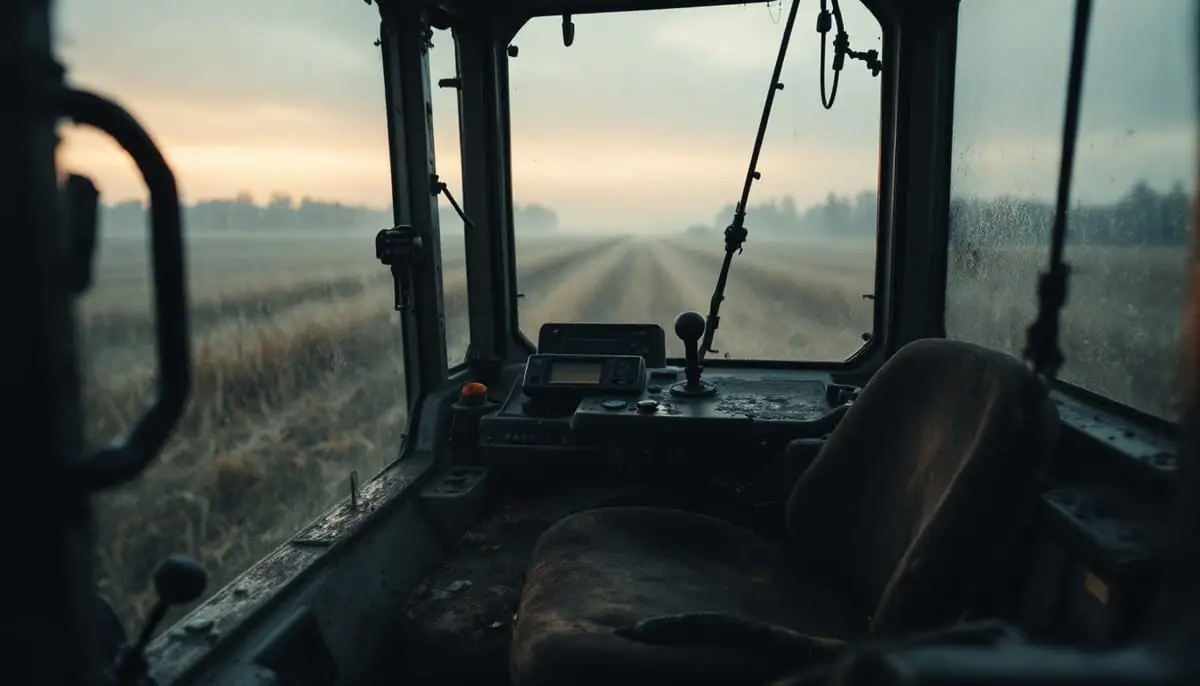
A modern combine harvester records the weight and moisture of the grain passing through it several times a second, tagged with satellite position. By the end of harvest it has drawn a detailed map of how every part of every field performed. The planter that went over the same ground in spring logged where each seed went and at what rate. The sprayer logged what it applied. The tractor logged its own engine hours, fuel use, location and every fault code it threw.
That record is enormously useful to the farmer. It is also useful to the equipment maker, the seed company, the agronomy platform, the lender, the insurer and, potentially, a commodity trader. The question of who gets to use it, and on what terms, has been argued over for more than a decade. In 2025 it has also become a question for courts and competition regulators, because the same software that collects the data controls whether a farmer can fix their own machine.
This piece works through the main questions and ends with a checklist for anyone reading a data agreement.
What gets collected?
Roughly, farm data falls into five groups:
- Agronomic data. Yield maps, planting and seeding rates, as-applied maps for fertilizer and pesticides, soil test results, field boundaries.
- Machine data. Telematics from tractors, combines and sprayers: location, engine and hydraulic performance, fuel, hours, diagnostic trouble codes.
- Sensor and imagery data. Weather stations, soil moisture probes, drone and satellite images, and in livestock farming, data from milking robots, feeding systems and animal-worn sensors.
- Business data. Input purchases, contracts, sales, field-level costs, often entered into farm-management software.
- Derived data. Prescriptions, benchmarks and recommendations produced by combining all of the above with other farms' data and with models.
The last group is where most of the commercial value lies, and where the farmer's say over what happens is weakest.
Do farmers own their data?
The honest answer is that "ownership" is the wrong legal frame for most of it. In many legal systems raw facts such as how much corn grew at a given point are not property in the way a building or a copyrighted text is. What actually governs the data is contract: the terms of service and licence agreements a farmer accepts when activating a machine's connectivity or signing up for a platform.
Many of those terms say the farmer owns the data. Read further and they often grant the provider a broad, sometimes perpetual and royalty-free licence to use it, combine it, analyze it and share it in aggregated or anonymized form. Ownership on paper, wide use in practice.
What do the platforms do with it?
The legitimate uses are real: improving agronomic models, offering benchmarking, diagnosing machine faults remotely, making service visits shorter. The concerns are about uses farmers did not anticipate and cannot see.
Aggregation. A platform that covers a large share of a region's acres can, in principle, see harvest results before official crop reports. Even "anonymized" data, pooled across many farms, can be commercially sensitive at that scale.
Vertical integration. The biggest platforms sit inside companies that also sell seed, chemicals or machinery. Bayer acquired Climate FieldView when it bought Monsanto in 2018; the major equipment makers run their own data platforms. The same company that holds your yield data may sell you the inputs that data helps price. That dynamic is one reason concentration ratios in agribusiness now matter for digital services, not just for seed and chemicals.
Lock-in. Years of field history stored in one platform's format make switching costly, even if the farmer technically can export it.
Re-identification. Field boundaries and yield maps are hard to truly anonymize. A field's shape is close to a fingerprint.
What about the voluntary codes?
In 2014 the American Farm Bureau Federation and a group of agricultural technology providers agreed a set of core principles for farm data: farmers should know what is collected, consent to its use, be able to retrieve it, and be told about sharing and sale. A certification program, Ag Data Transparent, followed, reviewing companies' contracts against those principles and letting them display a seal. Other countries followed with their own versions. European farm and agribusiness organizations published an EU code of conduct on agricultural data sharing by contractual agreement in 2018, Australia's National Farmers' Federation introduced a farm data code in 2020, and New Zealand has a farm data code of practice.
These codes have improved transparency. Contracts are clearer than they were a decade ago, and companies that sign up have to answer basic questions in writing. Their limits are just as clear: participation is voluntary, compliance is largely self-reported, and none of them sets limits on what a company may do once the farmer has agreed. They are disclosure regimes, not rights.
Does the law help?
In the United States, not much. There is no federal law specific to farm data, and general privacy laws mostly protect personal consumer data rather than business records. Some protection comes from contract law and trade secret law, which depend on what the farmer signed.
The European Union is about to go further. The EU Data Act, which applies from 12 September 2025, gives users of connected products – a category that clearly includes tractors and other farm machinery – a right to access the data their use generates and to have it shared with a third party of their choosing, such as an independent agronomist or repair shop. It also bars the data holder from using that data to derive insights about the user's economic situation, assets or production methods in ways that could undermine the user's commercial position. How strongly that clause is enforced will matter more than its wording. Where data relates to an identifiable person, as it often does on family farms, EU data protection law applies as well.
Right to repair: the data you can't reach
The farm data argument has a second front that many farmers feel more directly: repair.
Modern machines depend on software. A replaced sensor may need to be "paired" with the machine's controllers, a fault code may need clearing, a component may need calibration. Manufacturers have generally reserved the most capable diagnostic and programming tools for their authorized dealers. For a farmer facing a breakdown at harvest, that can mean waiting for a dealer technician and paying dealer rates, even if a skilled local mechanic or the farmer could do the job.
The fight has moved step by step:
- 2015. The US Copyright Office granted an exemption allowing owners to circumvent software locks on vehicles, including tractors, for repair. The exemption has since been renewed and broadened, but it does not oblige manufacturers to provide tools.
- 2021. The Federal Trade Commission sent Congress a report on repair restrictions across many industries, concluding there was little evidence to support most of them. A presidential executive order on competition that summer encouraged the FTC to address repair limits, citing farmers' equipment as an example.
- 2022 onward. Farmers filed private antitrust suits against Deere, later consolidated in federal court in Illinois.
- January 2023. Deere and the American Farm Bureau Federation signed a memorandum of understanding on access to repair tools and information. Critics noted it was not legally binding and included a commitment by the Farm Bureau not to promote state right-to-repair bills.
- April 2023. Colorado became the first state to pass a right-to-repair law specifically for agricultural equipment, which took effect in January 2024. Minnesota's broader digital repair law, passed the same year, left farm equipment out.
- January 2025. The FTC sued Deere in federal court in Illinois, alleging that it unlawfully restricts farmers and independent repair shops from the software tools needed to fully repair its equipment, inflating repair costs and delays. The states of Illinois and Minnesota joined the case. Deere has denied wrongdoing. As of August 2025 the case is at an early stage.
The connection to data is direct. Diagnostic codes are machine data. Whoever controls the software controls not just the farmer's information, but the farmer's ability to act on it.
A checklist for reading a farm data agreement
None of this is legal advice, and contracts vary. But these are the questions worth putting to any equipment dealer, platform or service provider before signing, and getting answered in writing.
| Ask | Why it matters |
|---|---|
| What data does the product collect, and can I see the full list? | Many products collect more than the features you use require. |
| Who owns the raw data, and what licence do you get over it? | "You own it" means little if the licence is unlimited and perpetual. |
| Do you share or sell data, in any form, to anyone? To whom, and for what? | Includes affiliates, partners and buyers of the company. |
| How do you define "aggregated" and "anonymized"? | Field boundaries can identify a farm. Ask how many farms an aggregate must include. |
| Can I opt out of data sharing and still use the core service? | Some services make sharing a condition of use. |
| Can I export all my data, including history, in a standard format? | Look for open formats; years of data in a closed format means lock-in. |
| What happens to my data if I cancel, or if you are sold? | Ask about deletion, timelines and whether it survives in backups and trained models. |
| Will you tell me if the terms change, and can I leave if they do? | Unilateral changes are common in online terms. |
| Will you notify me of a breach, and how quickly? | Farm records include financial and location data. |
| How do you respond to requests from governments or third parties? | Ask whether you will be told. |
| Can I or an independent mechanic get the diagnostic and calibration tools? | Repair access determines downtime and cost, especially at harvest. |
| Does the machine work fully if I disconnect telematics? | Some features may depend on connectivity. |
Two practical habits help as well. Keep your own copy of key records – yield maps, as-applied data, soil tests – outside any one platform, updated at least once a season. And where you have collective leverage, use it: farmer cooperatives and organizations can negotiate terms that an individual clicking "accept" cannot.
The larger question
Behind the contract details sits a wider argument about where value goes. Data generated on thousands of farms, combined and modelled, becomes a product that belongs to someone else and may be sold back to the farmers who produced it. That pattern has parallels well outside agriculture. Debates over digital sequence information turn on a similar point: genetic data drawn from resources held by communities and countries, used freely by companies that patent what they build with it.
It also echoes an older story. In the seed business, a handful of firms came to dominate the market through acquisitions over two decades, and some of those same firms now operate the leading digital farming platforms. The right to see, move and use your own data, and the right to repair your own equipment, are small but concrete checks on that concentration. They are worth asking for in every contract, even when the answer is no.

Written by Samir Haddad
Samir writes about technology and society – artificial intelligence, data, nanomaterials and digital farming – and about how new tools get governed, or not, once they leave the lab.