The turkey nobody chose: how a handful of breeders shaped the holiday bird
· 9 min read · by Marisol Ortega
Walk into almost any American supermarket in the week before Thanksgiving and you will find the same bird stacked in the freezer case: white-feathered, deep-breasted, sold by the pound under a dozen different labels. The packaging changes from store to store. The animal inside barely does.
That sameness is not an accident, and it is not the fault of anyone pushing a cart down the aisle. Nobody standing there chose this bird. The choice was made decades ago, in breeding barns most of us will never see, and it has been narrowed again and again until the turkey on most tables now descends from pedigree flocks held by a very small number of companies.
This is a short history of how that happened, what it cost, and who has been quietly keeping the alternatives alive.
A bird from Mexico
The turkey is American in the full, continental sense of the word. Wild turkeys were domesticated in Mesoamerica some two thousand years ago or more, and by the time the Spanish arrived the bird was a fixture of households across central Mexico. Its Nahuatl name, huexolotl, survives in Mexican Spanish as guajolote.
Spanish ships carried turkeys to Europe early in the sixteenth century. They spread quickly, quickly enough that English speakers ended up naming the bird after the wrong country. European farmers bred them into darker and paler types, and colonists later shipped those domesticated birds back across the Atlantic, where they mixed with wild North American turkeys. Out of that back-and-forth came the varieties American breeders formalised in the nineteenth century: the Bronze, the Narragansett, the Black, the Slate, the White Holland and, a little later, the Bourbon Red, developed in Bourbon County, Kentucky.
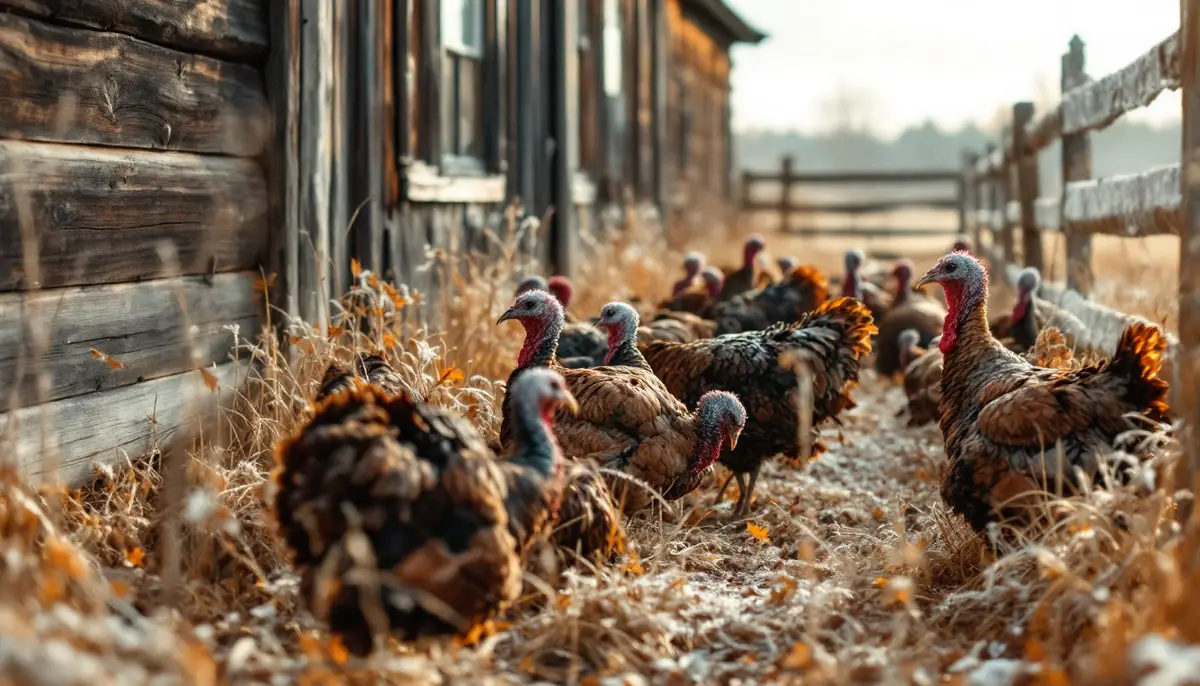
These were farm birds. They foraged in the stubble after harvest, picked grasshoppers and beetles out of the grass, and the hens sat on their own eggs. A family that kept a few could raise next year's flock without buying anything from anyone.
In Mexico, the guajolote never really left the patio. Backyard turkeys (mixed, unstandardised, often small and dark) are still part of rural household economies there, raised on maize and kitchen scraps, sold when cash runs short, killed for weddings, saints' days and mole. They are not a breed in the show-ring sense. They are something older: a population shaped by thousands of small decisions, very often made by the women who look after the yard animals.
Bred for the breast
The modern supermarket turkey comes out of twentieth-century breeding in North America and Britain. Through the 1920s and 1930s, breeders selected Bronze turkeys for more breast meat and produced the Broad Breasted Bronze. It sold well, but its dark pin feathers left small marks on the plucked skin, and processors and shoppers came to prefer a cleaner-looking carcass. White-feathered lines took over in the decades after the Second World War, and by the late 1960s the Broad Breasted White had become the industry's bird.
Selection never stopped. A commercial turkey now reaches slaughter weight in a matter of months, and the toms grow so heavy in the breast that they cannot mate naturally. Commercial flocks are bred by artificial insemination. That one fact tells you how far the bird has travelled from the animal a farmer once kept in the yard.
It also tells you who holds the keys. The bird in the freezer is the bottom step of a breeding pyramid. At the top sit pedigree lines, closely guarded and kept under strict biosecurity. Their offspring become great-grandparent and grandparent stock, which are multiplied into parent flocks, whose eggs hatch into the poults that growers raise. Growers buy poults; they do not breed them. The genetics flow one way, downhill, and the traits are chosen at the top.
Two names behind the bird
Trace that pyramid to its peak and, for turkeys, you find essentially two companies. Aviagen Turkeys, part of the privately held German EW Group, and Hybrid Turkeys, part of the Dutch firm Hendrix Genetics, supply most of the commercial turkey breeding stock used around the world. Older names, such as Nicholas and British United Turkeys, were absorbed along the way.
Turkeys are not unusual here. The same shape runs through the rest of the poultry business. Broiler chickens come overwhelmingly from Aviagen (EW Group again) and Cobb-Vantress, which belongs to Tyson Foods. Laying hens come mainly from EW Group's brands and from Hendrix Genetics. A shopper who buys a turkey, a pack of chicken thighs and a dozen eggs may be buying three supermarket labels from a dozen different farms, and the breeding programmes of perhaps two or three corporate groups.
Anyone who follows seeds will recognise the pattern. The commercial bird works a lot like hybrid seed: the end product of crossing proprietary parent lines, uniform and productive for one generation, and not something you can save and multiply at home with the same result. The seed trade went through its own version of this story, from dozens of seed houses to a handful of global firms, and the tools for reading concentration ratios in agribusiness apply just as well to animal genetics. The difficulty is data. The big breeding groups are mostly private, they publish little about volumes, and nobody tracks their market shares the way regulators track seed or fertiliser.
Concentration is not automatically sinister. Poultry breeding is slow, technical and expensive. A pedigree programme needs years of performance records, genomic testing and isolated farms, and a large firm can afford redundancy that a small one cannot: the major breeders keep their elite flocks on several sites, partly so that a single outbreak cannot wipe out a line. The more useful question is not whether these companies do their job well. It is what happens to everything they do not select for.
What falls out of the pyramid
A breeding programme optimises for what its customers pay for: feed conversion, growth rate, breast yield, uniformity on the processing line. Traits that do not show up in those numbers (foraging, mothering, tolerance of heat or rough housing, a long productive life) are not deliberately bred out. They are simply not carried forward, and over generations they fade.
Researchers have tried to measure the loss in chickens, where the genetic data are better. A study published in the Proceedings of the National Academy of Sciences in 2008, which compared commercial lines with older and non-commercial breeds, estimated that half or more of the genetic diversity found in the ancestral breeds was absent from the commercial lines. Turkeys have been studied less, but they have passed through an even narrower funnel, and there is no reason to expect they fared better.
Globally, the Food and Agriculture Organization has been warning about livestock breed loss for decades. Its Global Plan of Action for Animal Genetic Resources, adopted by governments at a conference in Interlaken, Switzerland, in 2007, committed countries to inventory and conserve their breeds. The inventories that followed are sobering in an unexpected way. For a large share of the world's local breeds, the official risk status is simply "unknown". Nobody has counted. A breed can disappear without anyone recording that it was ever in danger.
That matters most where industrial genetics meet conditions they were never bred for. A broad-breasted white turkey needs a climate-controlled house, formulated feed and a processing plant at the end of a predictable schedule. It does not do well scratching around a dry patio in Oaxaca on tortilla scraps, and nobody designed it to. As integrated poultry spreads, often through companies that supply chicks, feed and a buying contract all at once, the local birds that did fit those patios get crowded out. Not by any law. By price and convenience, one household at a time.
The waves of highly pathogenic avian influenza since 2022, which have led to the loss of more than a hundred million birds in the United States alone, most of them laying hens but turkey flocks too, have sharpened a different worry. It would be wrong to claim that heritage or backyard birds resist bird flu; they do not, and small flocks have been hit as well. The point is about the system. When nearly all the animals come from a few lines and are raised in very large, dense units, there are fewer places to turn if something goes badly wrong. Genetic diversity works like insurance. You hope never to claim on it, and you cannot buy it in a hurry.
The people keeping the old birds
In the United States the old turkey varieties came close to vanishing. When The Livestock Conservancy, then called the American Livestock Breeds Conservancy, surveyed heritage turkey breeding flocks in the late 1990s, it found so few breeding birds that several varieties looked close to extinction.
What followed is one of the better stories in farm conservation. Breed clubs, small farmers, Slow Food campaigners and a number of chefs began promoting heritage turkeys as something worth paying for, and later counts found breeding numbers far higher. The Livestock Conservancy's definition of a heritage turkey is worth knowing, because it reads like a list of everything the commercial bird is not: it must mate naturally, it must be able to live a long, productive life outdoors, and it must grow at a slow-to-moderate rate, taking roughly twice as long as a commercial bird to reach table weight.
Heritage birds cost more, and there is no point pretending otherwise. They eat more feed per pound of meat, they need space and time, and they come to the table leaner, with more dark meat and a stronger flavour than many people expect. Some cooks swear by them; some families try one and go back. A heritage turkey is not a moral test. It is a way of paying a farmer to keep a breed alive, and the price is roughly what that actually costs.
In Mexico the work looks different, because the guajolote does not need a revival so much as a future. Its survival depends on backyard farming staying viable, on families still having the time, the space and the reason to keep a few birds. Agricultural researchers at Mexican universities have studied these backyard populations, recording their variation and the knowledge of the households that keep them. That kind of conservation cannot happen in a freezer of semen samples. It happens on the farm, inside a way of farming, which is one reason agroecological approaches put as much weight on local breeds as on local seed.
Thursday's bird
None of this makes the bird in the freezer a bad thing to eat, or the people who raise it under contract villains. Most American turkey growers work inside a system they did not design either, often carrying the debt for the barns while someone else owns the birds and sets the terms.
But as the oven warms on Thursday, it is worth knowing that the turkey on the table is the end of a long chain of decisions made on our behalf: about what an animal should be, who should own its pedigree, and which of its ancestors were worth keeping. Those answers came from a very small number of breeding barns. Other answers are still out there, scratching around in a few thousand backyards and small farms from Kentucky to the Mixteca. They survive because somebody decided, against every price signal, to keep them.

Written by Marisol Ortega
Marisol covers seeds, smallholder farming and the rules that decide who may save, swap or sell them. She has spent a long time around maize fields and seed fairs and still thinks maize is the most political plant there is.