Brackets, blocs and the gavel: a reader's guide to how a UN climate COP works
· 9 min read · by Iris Calloway
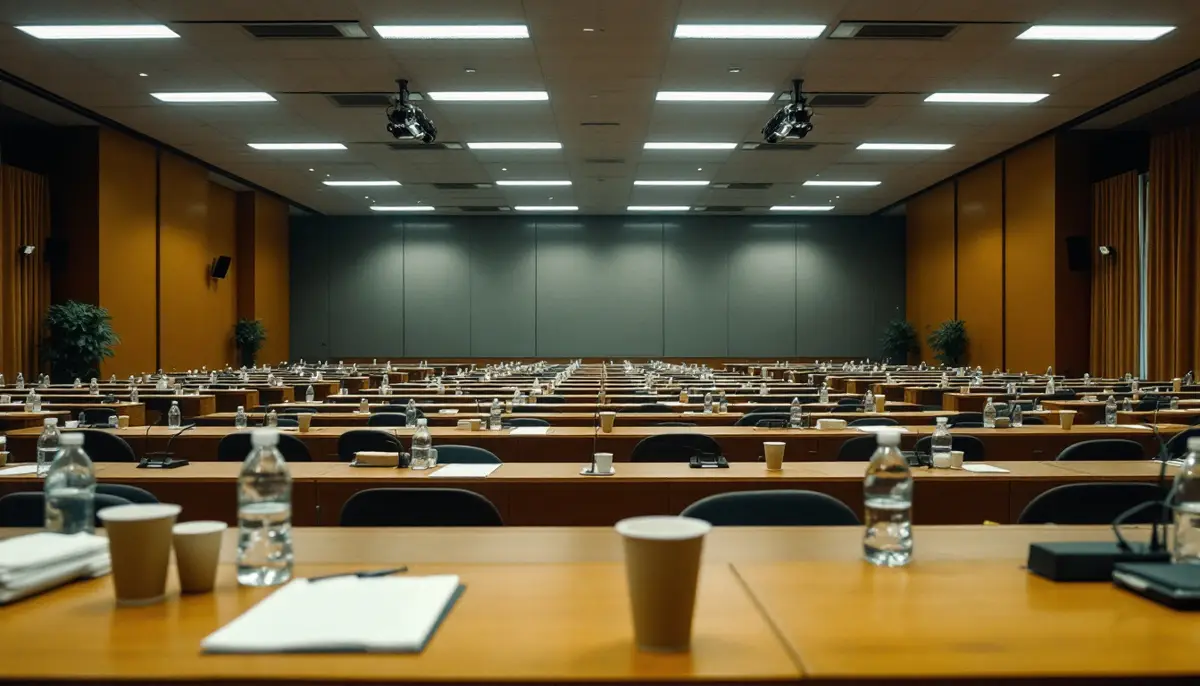
Every year, usually in November, a UN climate summit takes over the news for two weeks. The coverage clusters at the two ends: leaders' speeches at the opening, and an exhausted closing plenary a day or two after the scheduled finish, when a minister brings down a gavel and the room applauds or groans. What happens in between decides almost everything, and very little of it is televised.
What follows is an attempt to explain the machinery, written as answers to the questions readers tend to ask when they try to follow a COP properly. It is deliberately general: these rules have held for years, whoever happens to be hosting.
What is a COP, formally?
COP stands for Conference of the Parties, the parties being the countries, plus the European Union, that have joined the UN Framework Convention on Climate Change. The convention was opened for signature at the Rio Earth Summit in 1992, came into force in 1994 and now has 198 parties, which is to say almost everyone. The COP is its supreme decision-making body. It has met every year since the first session in Berlin in 1995, except 2020, when the pandemic pushed the Glasgow meeting back by a year.
The annual gathering is really several meetings sharing a venue. Alongside the COP sit the parties to the Kyoto Protocol (the CMP) and the parties to the Paris Agreement (the CMA). Membership differs slightly, so decisions carry different labels. The Paris Agreement itself was adopted by decision 1/CP.21 (the first decision of the 21st COP), but most of the rules that now matter are CMA decisions. When a headline says "the COP agreed", it often means one of the other bodies did.
Who is actually in the room?
Three kinds of people, with very different powers.
Party delegations negotiate. They range from several hundred people for a host or a large economy to a handful for some small island states, a real handicap when a dozen sessions run in parallel.
Most countries negotiate through blocs. The largest is the G77 and China, a coalition of more than 130 developing countries. It speaks with one voice when it can and splinters when it can't, because it contains sub-groups whose interests diverge: the Alliance of Small Island States, the Least Developed Countries, the African Group, the Arab Group, the Like-Minded Developing Countries (which include China, India and Saudi Arabia) and Latin American groupings such as AILAC. On the other side, EU member states negotiate as one, and several other developed countries coordinate in the loose Umbrella Group. A country can sit in several blocs at once, which is how coalitions shift from item to item.
Observers (accredited NGOs, business associations, research bodies, trade unions, indigenous peoples' organisations, youth groups and others, organised into constituencies) can attend many formal sessions and occasionally make short statements. They cannot negotiate, and they are usually kept out of the informal rooms where text is actually shaped.
Corporate presence has become a story of its own. Since 2023 participants have had to declare their affiliation when they register, and campaign groups that comb the lists have counted delegates linked to fossil-fuel companies in the thousands at both the Dubai and Baku COPs. Some arrive on national delegation badges, which open more doors than an observer pass.
Who sets the agenda, and why do people fight about it?
The secretariat drafts a provisional agenda with the incoming presidency, and parties can ask for items to be added. Adopting the agenda is the first decision of the session, and it is not a formality. An item on the agenda is a mandate: a contact group, a draft decision, a place in the final package. A topic without an item can only be raised sideways.
So agenda fights are substantive fights in procedural clothing. At COP27 in 2022, funding arrangements for loss and damage made it on to the formal agenda for the first time only after consultations that ran into the night before the opening. Once it was there, momentum carried it, and the conference ended with an agreement to set up a fund.
Where does the text come from?
Mostly not from the summit. Negotiations run all year. Two permanent subsidiary bodies, one for scientific and technological advice (SBSTA) and one for implementation (SBI), meet every June in Bonn and again during the COP. They carry most items forward, and many arrive at the summit with a draft already half-built.
Each item is run by two co-facilitators, usually one from a developed and one from a developing country. They produce successive drafts, often labelled "informal note" or "non-paper", which have no formal status and can be torn up. As the fortnight goes on, texts harden. Late in the second week, drafts appear as official documents with an "L" in the symbol: limited distribution, meaning a text proposed for adoption.
On top of the item-by-item decisions sits the cover decision, an overarching text the presidency drafts and names: the Glasgow Climate Pact in 2021, the Sharm el-Sheikh Implementation Plan in 2022. Nothing in the rules requires one. But it is where the headline language usually lives, and it is the text on which presidencies spend their political capital.
What do the square brackets mean?
Square brackets mark text that is not yet agreed. A draft might read "[developed country Parties shall][Parties in a position to do so are encouraged to] provide…", with each option backed by a different camp. Removing them, by picking an option or finding a third wording, is called "cleaning the text".
Counting brackets is a crude but useful gauge. A draft with hundreds of them at the end of week one is normal. A short draft with a handful left on the one paragraph that matters, on the scheduled final Friday, may be in more trouble.
The verbs carry the weight. "Shall" creates an obligation; "should" is advice; "urges", "encourages" and "invites" descend from there. A COP that "takes note of" a report has declined to endorse it. Qualifiers do quiet work too: "Parties in a position to do so" lets large emerging economies contribute without accepting a duty to. The formula on differentiation that made Paris possible (common but differentiated responsibilities and respective capabilities, "in the light of different national circumstances") borrowed that last clause from a US-China announcement in November 2014, and it eased a quarrel that had dogged the talks for years. The best-known example is Glasgow in 2021, where the final text called for a "phase-down" rather than a "phase-out" of unabated coal power after a late change pushed by India. One word, several months of commentary.
How is finance negotiated?
Finance runs through nearly every item. Developing countries link their own ambition to the support they receive. Developed countries push for every major economy to commit more on emissions. The two demands are traded against each other until the final hours.
Underneath sits a list drawn up in 1992. The convention's Annex II named the wealthy OECD members of that era as the countries obliged to provide finance. China, the Gulf states, South Korea and Singapore are not on it. Article 9 of the Paris Agreement keeps the distinction: developed countries "shall" provide finance, and others are encouraged to do so voluntarily. Much of the heat in any finance negotiation comes from arguing over whether a 1992 list still describes the world.
The numbers matter as much as the categories. The goal of $100 billion a year by 2020, promised at Copenhagen in 2009, was by the OECD's own accounting met only in 2022. Its successor, agreed at Baku in 2024, set a target of at least $300 billion a year by 2035, alongside a call to raise $1.3 trillion a year from all sources. Several developing countries objected to the decision as it was gavelled through. Behind each figure sit further fights: grants or loans, public or private money, and whether a loan at near-commercial rates should count at face value. I looked at one corner of this, who the "support" actually serves, in a piece on climate technology transfer.
Is there a vote?
No. The parties have never formally adopted their rules of procedure, because they could not agree on the voting rule. The draft rules are applied minus that rule, and decisions are therefore taken by consensus.
Consensus is not unanimity. The presiding officer judges whether there is a formal objection, and presidents have gavelled through texts over protests. At Cancún in 2010, Bolivia objected to the final package; the Mexican presidency noted the objection and declared the decisions adopted. At Dubai in 2023, small island delegates complained that the stocktake decision had been gavelled while they were still outside the hall.
My own view is that consensus is the best protection small states have: no bloc of large emitters can simply outvote Tuvalu. It is also why one determined producer can hollow out a sentence about fossil fuels. Both things are true, and reform proposals that see only one of them deserve caution.
Why does it always run late?
Because "nothing is agreed until everything is agreed". Items are bundled into a package, and nobody gives ground on their priority until they see what they are getting on everyone else's. Ministers arrive in the second week, the presidency pairs them up to broker the hardest items, and leverage peaks at the end. Madrid in 2019 ran almost two days over schedule; Baku in 2024 also went deep into overtime.
Overruns are not neutral. Large delegations can rotate staff and rebook flights. A three-person delegation that has slept six hours in four nights cannot, and some of the texts most disappointing to vulnerable countries have been agreed in exactly those conditions.
Who really holds the pen?
The presidency. It rotates among the UN's five regional groups, and a minister from the host country presides. The presidency team decides when to issue new text, which brackets to resolve and how, which ministers to send into which room, and when to gavel. At Durban in 2011, a deadlock between the EU and India was broken in a huddle on the plenary floor that produced the phrase "an agreed outcome with legal force", vague enough for both sides to accept, solid enough to launch the talks that led to Paris.
Who holds the presidency therefore matters. In 2023 the COP28 president was also chief executive of the UAE's national oil company, and observers asked, reasonably, whose interests the pen would serve. The question applies in quieter forms every year: read a presidency's drafts more closely than its press statements.
What should a reader watch?
- The agenda on day one. A clean adoption or a fight tells you where the trouble is.
- The verbs and qualifiers in the operative paragraphs, not the preamble.
- What gets "noted" rather than adopted or welcomed.
- Where the money language lands: in the cover decision, where it is political, or in an operative finance decision, where it has teeth.
- What is postponed "to the next session". Much of the real outcome is the work programme handed on to Bonn in June.
- Who speaks after the gavel. Statements in the closing plenary are where objections go on the record.
A COP is less a summit than an annual deadline in a negotiation that never stops. The same UN machinery set the long road to Rio+20, and it runs, with its own blocs and brackets, through the biodiversity talks that produced the Cali Fund. The secretariat posts the drafts on the UNFCCC website as they appear. Reading two versions side by side, a day apart, tells you more about who is winning than any press conference will.
Written by Iris Calloway
Iris follows climate negotiations, carbon markets and the growing list of proposals to engineer the climate itself, from solar geoengineering to ocean fertilisation. She is interested in who gets to decide, and who carries the risk.