Nitrogen, potash and phosphate: who controls fertilizer, and why the price swings
· 9 min read · by Joaquín Ferreyra
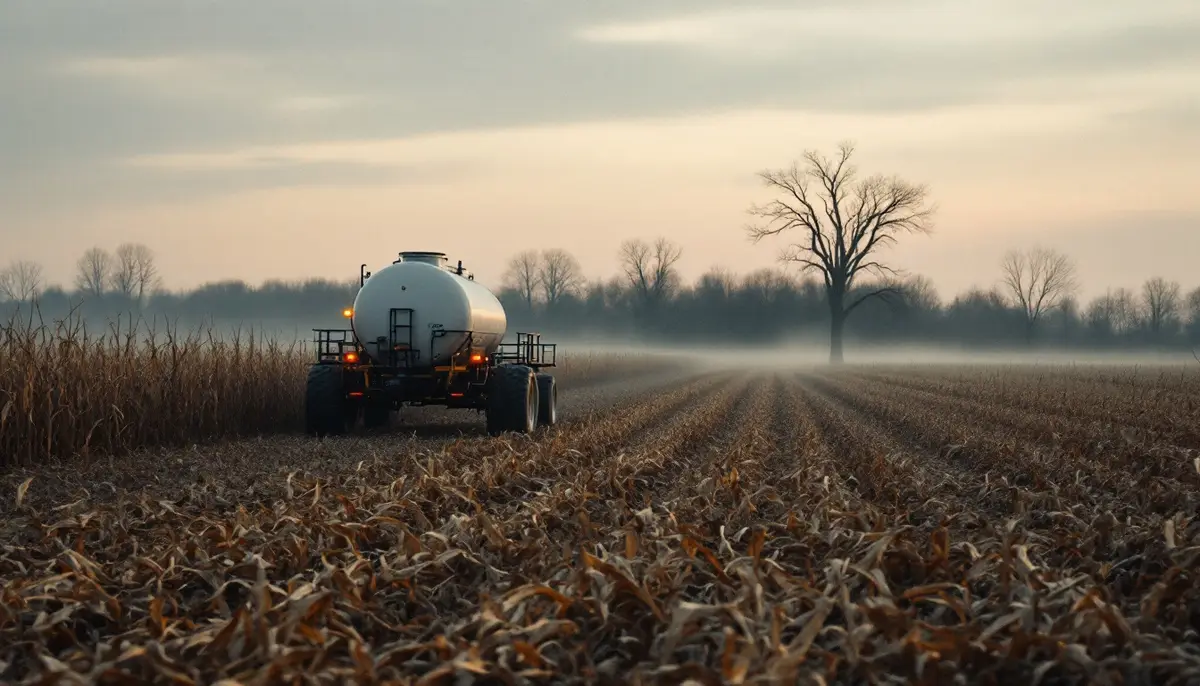
In much of the US Corn Belt, November is ammonia season. Once the harvest is in and the soil has cooled, white nurse tanks on steel wheels appear at field edges, and toolbars knife anhydrous ammonia into the stubble for next year's corn. Dealers, meanwhile, are taking orders for spring. On many grain farms the fertilizer bill is among the largest of the year, and it is the one the farmer has the least say over.
Ask why that bill moved and the answer is usually "fertilizer prices". But fertilizer is not one market. The three main nutrients (nitrogen, phosphorus and potassium, the N, P and K printed on every bag) come from different raw materials, are made by different companies in different countries, and react to different shocks. One is an energy business. One is a mining business with a single dominant country. The third is about as close to an oligopoly by nature as anything a farmer buys.
The tables below set them side by side, using rankings and rough shares because exact figures move every year; the US Geological Survey's annual Mineral Commodity Summaries carry the current ones.
Three nutrients, three industries
| Nitrogen (N) | Phosphate (P) | Potash (K) | |
|---|---|---|---|
| Made from | Nitrogen from the air plus hydrogen, usually stripped from natural gas (from coal in much of China) | Mined phosphate rock dissolved in sulfuric acid; the common products, DAP and MAP, also contain ammonia | Potassium salts mined from the beds of ancient evaporated seas |
| Biggest cost | Natural gas, which is both feedstock and fuel | Rock, sulfur and ammonia | Building and running deep mines, then rail and ports |
| Where supply sits | Wherever gas or coal is cheap: Russia, the Gulf, North Africa, Trinidad and Tobago, the US, China | Morocco holds roughly 70 percent of known reserves; China mines the most rock; the US, Russia and Saudi Arabia are other large producers | Canada, mainly Saskatchewan, leads; Russia and Belarus follow; smaller output in Germany, Israel, Jordan, Chile and China |
| Big sellers | CF Industries, Yara, Nutrien, Koch, plus large Russian, Gulf and Chinese producers | OCP (Morocco's state company), Mosaic, Ma'aden, PhosAgro, Chinese producers | Nutrien, Mosaic, Uralkali, Belaruskali, K+S, ICL, Arab Potash |
| Typical shock | Gas price spikes, export curbs | Export curbs, trade duties | Sanctions, joint selling starting or ending |
Nitrogen can be made wherever energy is cheap, so it has many producers. Phosphate and potash can only be dug where geology put them, and geology was not even-handed.
Nitrogen: an energy business in disguise
Every nitrogen fertilizer starts as ammonia, made by the Haber-Bosch process. Fritz Haber showed in 1909 that nitrogen from the air could be combined with hydrogen under heat and pressure; BASF, with Carl Bosch, had an industrial plant running by 1913. The hydrogen is the expensive part. In Europe and North America it is mostly stripped from natural gas, which also fuels the process, so gas makes up most of the cash cost of a ton of ammonia.
That makes the nitrogen price, roughly speaking, a gas price with a lag. When European gas prices soared in the autumn of 2021, Yara cut ammonia output across Europe and CF Industries halted its two British plants. As an unplanned side effect, British food processors ran short of the carbon dioxide those plants make as a by-product. Russia's invasion of Ukraine in February 2022 pushed gas, and nitrogen with it, higher still.
Globally, nitrogen is the most competitive of the three markets. Russia, the Gulf states, Egypt, Algeria, Trinidad and Tobago, the US and China all produce large volumes. Regional markets are tighter. In North America, CF Industries became the largest producer after buying Terra Industries in 2010, beating a rival bid from Norway's Yara. When CF later sought duties on UAN, a liquid nitrogen fertilizer, imported from Russia and Trinidad, the US International Trade Commission turned the case down in 2022, to the relief of farm groups.
Demand matters too. Corn is the hungriest major crop for nitrogen, and in most years roughly a third of the American crop goes into ethanol, so fuel policy reaches straight into the fertilizer market. How biofuel mandates pulled crops into fuel tanks is a story told elsewhere on this blog.
Phosphate: one country's geology
Phosphate rock is dissolved in sulfuric acid to make phosphoric acid, most of which is then combined with ammonia into DAP or MAP. So phosphate producers feel gas prices too, second-hand.
The concentration is in the rock. By USGS estimates, Morocco, counting the disputed territory of Western Sahara, holds around 70 percent of the world's known phosphate reserves. Its state-owned OCP, founded in 1920, is the largest exporter of phosphate in its various forms. China mines more rock than anyone, but since late 2021 it has held back fertilizer exports through inspection requirements, putting its own farmers first, which can take a very large supplier off the world market whenever Beijing chooses.
The United States has its own deposits and one dominant domestic producer: Mosaic, created in 2004 when Cargill combined its fertilizer business with IMC Global. In 2021, after a petition from Mosaic, the US imposed countervailing duties on phosphate fertilizer from Morocco and Russia. Imports from both fell sharply, American farmers paid more than buyers elsewhere, and OCP fought the duties in US courts for years. Whatever one makes of the subsidy argument, the effect was to make the US phosphate market more of a home market for its biggest local seller.
You will sometimes read that the world is running out of phosphorus. On current reserve estimates that isn't the near-term problem; the problem is that the reserves sit overwhelmingly in one place, and nothing substitutes for the element itself.
Potash: the closest thing to a cartel farmers face
Potash comes from beds of potassium salts left by seas that evaporated hundreds of millions of years ago. Workable deposits are few, deep and expensive; a new mine can take a decade and billions of dollars. BHP approved its Jansen mine in Saskatchewan in 2021, and like most potash projects it has taken years to work toward first production.
In Canada, two companies dominate: Nutrien, formed in 2018 when PotashCorp and Agrium merged, and Mosaic. They sell their overseas potash jointly through Canpotex, an export marketing company they own, and joint selling for export is lawful under Canadian competition law. Run the four-firm concentration ratio I walked through in an earlier piece on world potash and you get a number that would stop most merger reviews cold. Geology and history built it, not any one deal.
The clearest evidence of what joint selling does came from its absence. For years Russia's Uralkali and Belarus's Belaruskali sold together through the Belarusian Potash Company. In July 2013 Uralkali walked out, announcing it would put volume ahead of price. Potash prices fell, and the split turned into a diplomatic incident when Belarus arrested Uralkali's chief executive in Minsk that August. The market behaved as if a source of discipline had disappeared, which is more or less what had happened.
Then came sanctions. The EU and the US moved against Belarusian potash in 2021, and in February 2022 Lithuania stopped it crossing to the port of Klaipėda, its main export route. Russia and Belarus together had supplied roughly 40 percent of world potash exports. Western sanctions largely spared Russian fertilizer to protect food supplies, but banks, insurers and shipowners grew cautious anyway, and prices reached records in 2022.
Geography adds one more pinch point. Saskatchewan potash leaves by rail, and the US imports most of its potash, overwhelmingly from Canada. When Canada's two big railways locked out their workers in August 2024, briefly, American farm costs were part of the story.
What actually moves the price
| Driver | How it works | Hits hardest | Example |
|---|---|---|---|
| Energy | Gas is ammonia's feedstock and fuel; ammonia also goes into DAP and MAP | N, then P | Europe, autumn 2021 into 2022 |
| Crop prices | When grain pays well, farmers apply more and sellers price to what the crop can bear | All three | 2008; 2021-22 |
| Export policy | Producing governments keep supply at home to protect their own farmers | N and P | China's export inspections from late 2021 |
| Sanctions and war | Routes close, banks and insurers hesitate, buyers pay for risk | K, N | Belarus from 2021; Russia from 2022 |
| Logistics | Bulky, seasonal cargo; a blocked river or railway hits at the worst moment | All, especially inland | Low water on the Mississippi, autumn 2022; Canadian rail lockouts, August 2024 |
| Market structure | A few sellers can idle capacity or hold back volume rather than cut price | K most, then P | The 2013 Belarusian Potash Company split |
Pricing to the crop
One row in that table causes more argument than the rest. Fertilizer prices tend to follow crop prices, not just production costs: when corn pays well, farmers can afford to pay more, and sellers price accordingly. The big listed producers (CF, Nutrien, Mosaic, Yara) reported record or near-record earnings in 2022, the year crop and fertilizer prices peaked together.
Producers have a fair reply: they run capital-heavy plants and mines through long cycles, and in lean years, such as the mid-2010s, prices barely covered costs. Farm groups have a fair complaint too: prices seem to climb with crop prices faster than they fall with gas prices, and in phosphate and potash there are few enough sellers that this is hard to call coincidence. In 2022 the US Department of Agriculture asked the public for evidence on competition in fertilizer and launched a grant program for new, independent production.
Both can be true. A cyclical commodity can also be a concentrated one, and concentration decides who keeps the upswing.
What would change it
More sellers. Grants for smaller, regional nitrogen plants can add competition at the edges, though small ammonia plants struggle to match the costs of large ones.
Different hydrogen. "Green" ammonia, made with hydrogen split from water using renewable electricity, would cut nitrogen's tie to gas. Many projects have been announced; few run at commercial scale, and their ammonia costs more. Green industrial promises have a mixed record (the green economy debate was full of them), but this one comes with a simple test: delivered price per ton.
Needing less. Legumes in the rotation, manure, cover crops, split applications and soil testing all cut how much a farm has to buy. It is the least glamorous answer and the one most within a farm's control; some of the practices are described in the piece on agroecology on the farm.
A winter watch list
For anyone booking spring fertilizer in the coming weeks, here is what to watch. None of it is printed on the bag.
- Gas prices in Europe and North America through the heating season, which set a floor under nitrogen.
- China's export inspections for urea and phosphate ahead of spring.
- Sanctions, insurance and freight for Russian and Belarusian cargoes.
- Rail and port labor in Canada, for potash.
- The ratio between the fertilizer price and the crop price you expect at harvest: the number that tells you whether the invoice reflects what the product cost to make, or what the market thinks you can bear.

Written by Joaquín Ferreyra
Joaquín tracks mergers, market shares and the business models behind agribusiness, pharma and big tech. He likes a good concentration ratio and distrusts any market where four companies sell most of everything.